

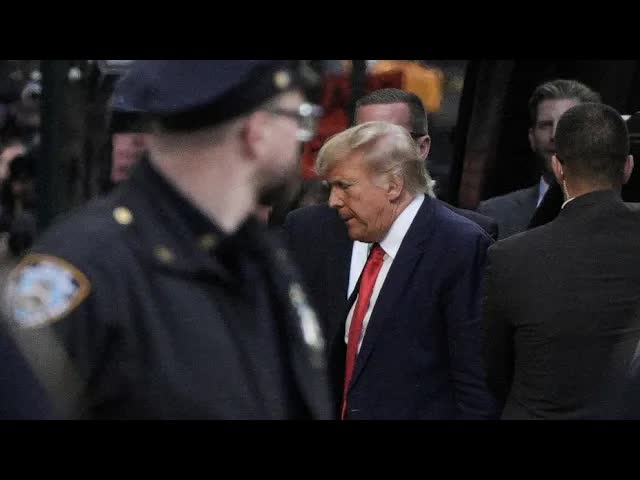
In a recent rally in Arizona, former President Donald Trump made incendiary comments regarding Liz Cheney, a vocal critic of his administration.
He suggested that she should be put in a position where she would face a barrage of gunfire, igniting a firestorm of controversy and prompting an investigation by state authorities.
This statement, which many interpret as a threat, has raised serious concerns about the implications of such rhetoric in today’s politically charged atmosphere.
Arizona Attorney General Chris Mays did not mince words when addressing Trump’s remarks.
She emphasized the gravity of the situation, stating that it was “outrageous” for Trump to make such statements, especially in a state preparing for elections.
Mays revealed that she had instructed her criminal division chief to examine Trump’s comments closely to determine if they could be classified as a death threat under Arizona law.
The seriousness of the matter cannot be overstated, particularly as the state gears up for a crucial electoral process.
While Trump’s supporters may argue that his comments fall under the umbrella of political discourse and free speech, Mays believes they cross a troubling line.
She expressed her concern that such incendiary language only serves to inflame tensions and create an unsafe environment, especially in the lead-up to elections.
The need for a peaceful and orderly voting process is paramount, and statements like Trump’s complicate those efforts significantly.
Critics have pointed out the hypocrisy in Trump’s behavior.
Just days prior, he had feigned outrage over a comment made by President Joe Biden, labeling it as uncivilized while simultaneously calling for violence against his political opponents.
This double standard raises questions about the sincerity of his claims regarding civility in political discourse.
In defending his remarks, Trump doubled down, labeling Cheney a “war hawk” and accusing her of advocating for military action during his presidency.
He claimed that if she were truly confronted with the realities of battle, she would rethink her stance.
This justification has been met with skepticism, as many view it as an attempt to rationalize his aggressive rhetoric rather than a genuine critique of Cheney’s political positions.
The reactions to Trump’s comments have been mixed, with some defending him as merely expressing frustration with Cheney’s policies.
However, others, including conservative figures, have condemned his words as dangerously reckless.
Judge Ludwig, a prominent conservative voice, described Trump’s remarks as “reprehensible” and warned that such language could have dire consequences for the political landscape in America.
The chilling effect of Trump’s comments extends beyond mere political posturing.
As the nation approaches election day, the atmosphere in places like Maricopa County has become increasingly fraught with tension.
Local law enforcement is preparing for potential unrest, with officials implementing strict measures to ensure voter safety.
This reflects a broader reality where elections are no longer just routine democratic exercises but high-stakes events fraught with the potential for violence.
A reporter who spoke with Attorney General Mays highlighted the precarious nature of the upcoming election, noting that it has become a “high security event.”
This stark reality underscores the extent to which Trump’s rhetoric has altered the political landscape, transforming what should be a celebration of democracy into a situation where citizens feel unsafe at the polls.
The ramifications of Trump’s divisive language are profound.
Many fear that the current climate could lead to a future where political disagreements escalate into violence.
The notion that elections could be conducted peacefully and that losing candidates would accept the results seems increasingly distant in this context.
As the nation grapples with these issues, the call for unity and civility has never been more critical.
Figures like Vice President Kamala Harris have emphasized the importance of dialogue and inclusion, contrasting sharply with Trump’s combative approach.
Such messages resonate with those yearning for a return to a more respectful and functional political discourse.
Ultimately, the stakes are high as America stands at a crossroads.
The choice voters make in the upcoming election will have lasting implications for the future of democracy.
If citizens wish to reject the chaos and violence that have permeated the political sphere, they must consider the consequences of their decisions carefully.
As the nation watches closely, it remains to be seen whether Trump’s influence will continue to shape the political narrative or if a collective desire for change will prevail.
The outcome could very well define the trajectory of American politics for years to come.
Read more
