
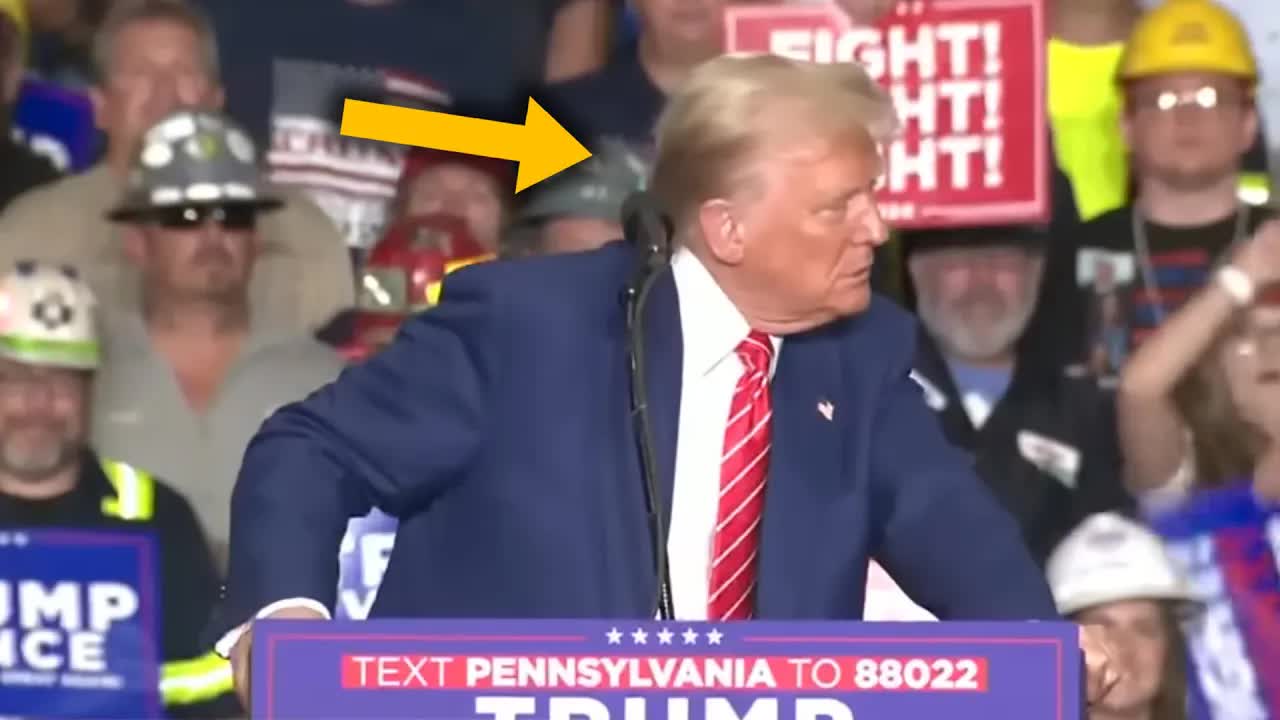
In a series of recent rallies held in Johnstown, Pennsylvania, and Pottersville, Michigan, former President Donald Trump appeared visibly distressed, drenched in sweat, and sporting a swollen right eye.
His condition raised eyebrows as he delivered remarks that many found perplexing.
Observers noted that this was perhaps one of the most unusual presentations from Trump yet, leaving attendees and commentators alike questioning his mental clarity.
During these events, Trump launched into a bizarre monologue, weaving together seemingly unrelated topics such as sharks, electric vehicles, and even Kamala Harris.
He boasted about his storytelling abilities, claiming that English professors were astounded by his unique approach to language.
“I do the weave,” he said, suggesting that his ability to connect disparate ideas was nothing short of genius.
Yet, critics were quick to label his ramblings as signs of a troubling mental state.
At one rally, chaos erupted when an audience member attempted to confront the media.
In a scene reminiscent of past events, the individual climbed onto a raised platform where reporters were stationed, aiming to attack them.
This incident highlighted the tension often present at Trump’s rallies, where he has consistently branded the press as the “enemy of the people.”
The situation escalated quickly, drawing police intervention and resulting in a chaotic scene that left many onlookers divided in their reactions.
The connection between Trump’s inflammatory rhetoric and the actions of his supporters was evident.
His past comments have often incited aggressive behavior among attendees, raising concerns about the potential for violence.
As the rally continued, Trump’s profuse sweating and erratic statements only added to the sense of unease that permeated the atmosphere.
In a particularly troubling moment, Trump claimed that he was someone who truly understood the needs of the American people.
“I have your back, I have your heart, and I have every other part of your body,” he declared, a statement that drew laughter from some but left others scratching their heads.
The implications of such remarks seemed to blur the lines of sincerity and absurdity.
Trump also made headlines with a comment regarding Congressman Byron Donalds, who is Black.
He referred to Donalds as “one of the smart ones,” suggesting a troubling dichotomy between those he deemed intelligent and others he didn’t.
This statement sparked debates over whether it reflected overt racism or merely a lack of awareness on Trump’s part.
In another odd twist, Trump claimed that no one knows Kamala Harris’s last name, despite mispronouncing her first name in his own commentary.
This contradiction did not go unnoticed, as many questioned how someone could claim ignorance about Harris while simultaneously struggling with her name.
It seemed to encapsulate the confusion that often characterizes Trump’s speeches.
Perhaps the most surprising moment came when Trump appeared to endorse Kamala Harris for president, albeit in a roundabout way.
He asserted that the American public would not be swayed by Hollywood or the media, suggesting that they deserved a leader who genuinely respects them.
Ironically, this assertion stood in stark contrast to his own track record.
In a bizarre tangent, Trump repeatedly invoked Barack Obama’s middle name, “Hussein,” which many interpreted as a veiled racist reference.
This tactic, reminiscent of past political strategies, aimed to provoke a reaction while diverting attention from pressing issues.
The mention of Obama seemed to serve no purpose other than to stir up controversy.
As the rallies progressed, it became clear that Trump’s messages were increasingly falling flat.
Major news outlets like CNN and Fox News began to distance themselves from his speeches, often cutting away before they concluded.
The once-captive audience seemed to dwindle, signaling a potential shift in public interest.
Amidst the confusion and chaos, Trump hinted at a new strategy: conducting interviews to build a narrative that he engages with the public more effectively than his opponents.
This move seemed desperate, particularly in light of Harris’s recent media engagements that contradicted his claims.
In the end, Trump’s rallies served as a microcosm of his political journey—marked by confusion, controversy, and a growing disconnect with mainstream media.
As he continues to navigate the political landscape, one has to wonder whether these chaotic displays will resonate with voters or push them further away.
Read more
