
In a recent series of events, Donald Trump has found himself embroiled in a controversy over crowd sizes at his rallies, leading to some pointed accusations aimed at Vice President Kamala Harris.
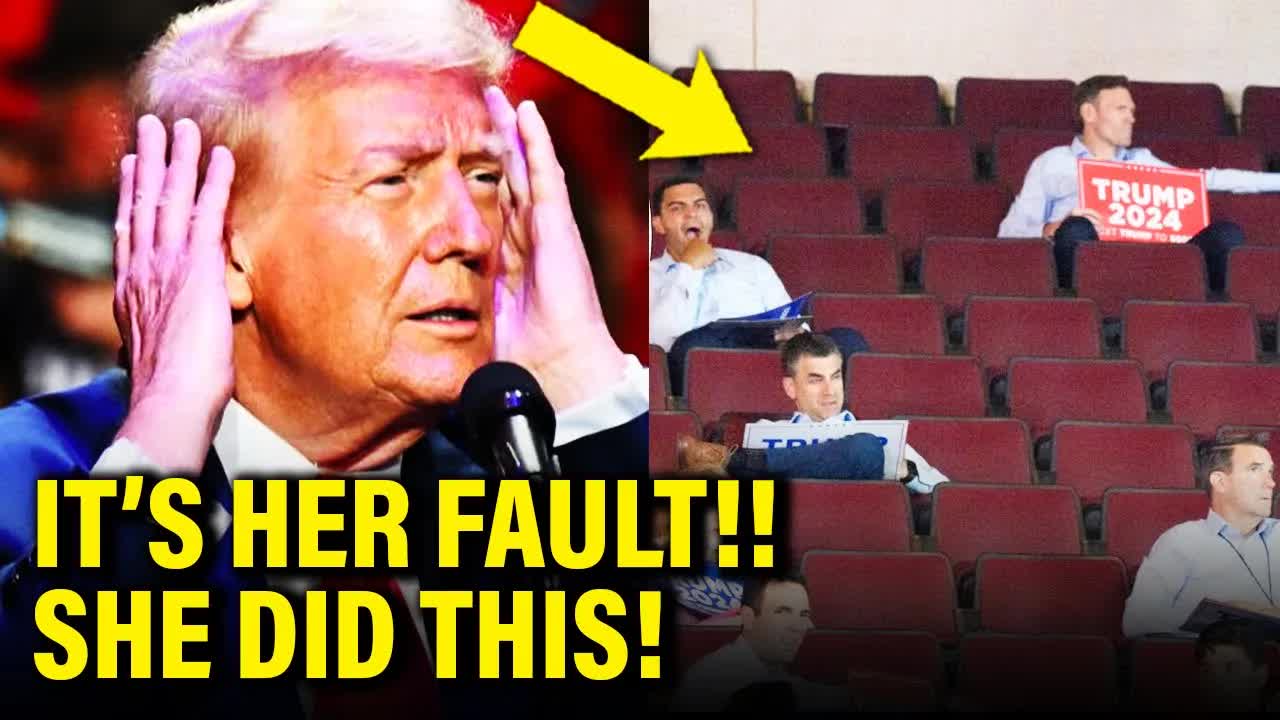
During a rally that was supposed to accommodate a massive outdoor crowd of 50,000 supporters, Trump ended up speaking to just around 1,000 people indoors.
The administration’s refusal to provide adequate security for the outdoor event, allegedly due to the presence of the Iranian president, has become a focal point of Trump’s rhetoric.
Trump has repeatedly taken to social media to express his frustration, blaming Harris for what he perceives as an inability to manage crowd control.
He claimed that rather than showcasing a large gathering, he was forced into a small arena.
His posts have been laced with defiance, insisting that despite the restrictions, the spirit of his supporters remains undeterred.
“Kamala wouldn’t allow for protection to take care of this crowd,” he stated, challenging her capabilities and leadership.
This isn’t the first time Trump has faced scrutiny over the size of his audiences.
Recent rallies in places like Savannah, Georgia, and Wisconsin have drawn minimal crowds, prompting some attendees to leave mid-speech.
Trump’s self-awareness regarding these dwindling numbers seems to be a source of anxiety, as he often tries to downplay the exodus, claiming that those departing are merely shifting positions for better views.
The stark contrast between Trump’s small gatherings and Harris’s more populous events has not gone unnoticed.
During a debate, Harris directly addressed Trump, highlighting the disparity in their crowd sizes.
Her comment seemed to resonate, as it has become a recurring theme in Trump’s subsequent speeches, where he attempts to assert that his rallies are still drawing significant interest.
As Trump continues to address his supporters, he finds himself increasingly defensive about the attendance figures.
In Wisconsin, he insisted that there were “thousands and thousands of people” outside waiting to get in, despite the reality being far less impressive.
His attempts to paint a picture of overwhelming support often clash with the actual turnout, leading to a narrative that many are quick to challenge.
The situation escalated during a speech in Walker, Michigan, where Trump remarked on the apparent departures from his audience, attributing them to anything but disinterest.
“It looks like they’re leaving, but they’re not actually leaving,” he claimed, a statement that raised eyebrows among observers.
The disconnect between his words and the visible reality of the crowd has led to skepticism regarding his assertions.
Moreover, Trump’s speeches have taken on a bizarre tone, veering off into tangents that confuse listeners.
In one instance, he attempted to draw a comparison between his rally experiences and historical events, likening the crowd’s enthusiasm to that of Charles Lindbergh’s arrival in New York.
Yet, these analogies often miss the mark, leaving many wondering about the coherence of his message.
In a notable instance, Trump mentioned an unverified claim about immigrants harming pets in Springfield, Ohio, which the city manager later refuted.
This incident illustrates the sometimes chaotic nature of Trump’s rhetoric, where sensational claims overshadow factual accuracy.
His tendency to embellish stories has raised concerns about the implications of such narratives on public perception.
Despite these challenges, Trump remains committed to his campaign strategy, which emphasizes a return to what he calls “making America great again.” He frames his rallies as essential gatherings for those who feel disenfranchised, yet the reality of his audience sizes suggests a different story.
The stark juxtaposition between his claims and the actual turnout has become a defining characteristic of his recent appearances.
As Trump navigates this tumultuous landscape, the pressure is mounting.
With the 2024 election cycle approaching, the stakes are high.
His ability to galvanize support will be crucial, and the ongoing narrative surrounding crowd sizes may play a significant role in shaping public opinion.
Amidst all this, Vice President Harris appears to be gaining traction, filling stadiums while Trump grapples with dwindling crowds.
The dynamic between the two continues to evolve, with Harris poised to capitalize on Trump’s vulnerabilities.
As the political landscape shifts, the question remains: can Trump reclaim the narrative, or will he continue to be overshadowed by his rival’s growing popularity?
Read more
