
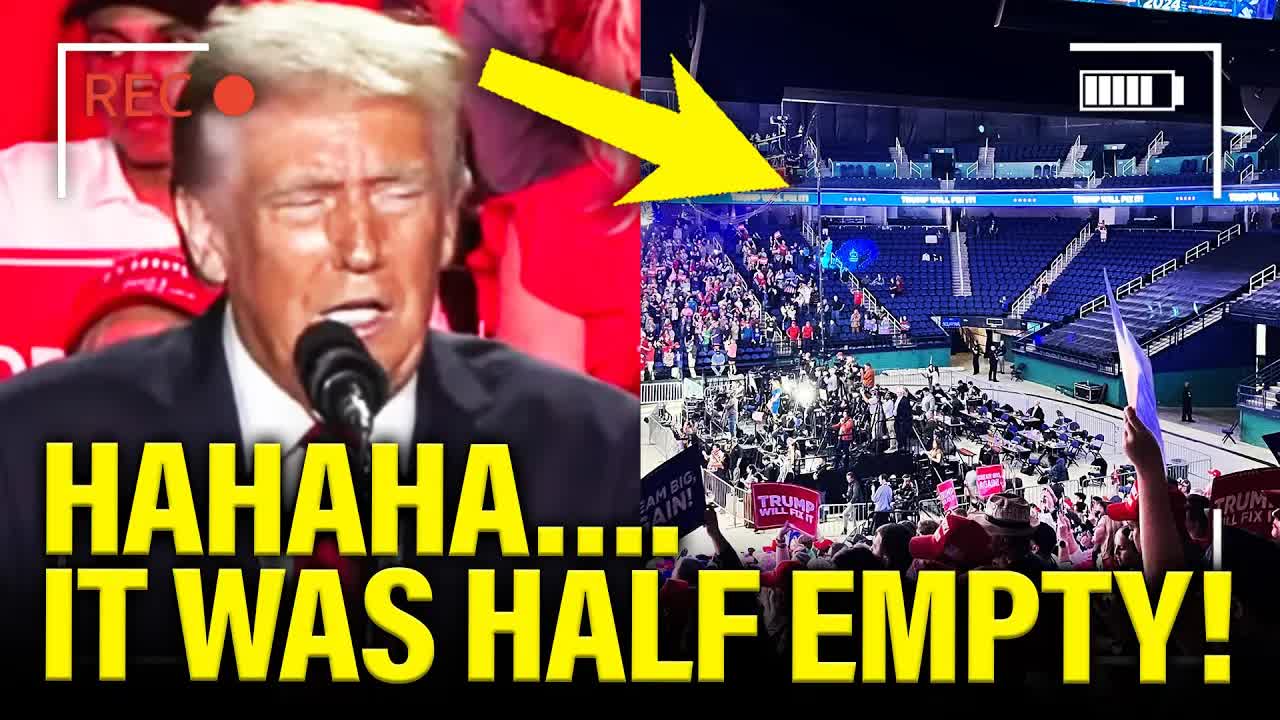
In a recent rally held in Greensboro, North Carolina, Donald Trump faced a stark reality as he addressed a crowd that was notably sparse.
Observers noted that the stadium was more than half empty, casting doubt on the former president’s influence and appeal.
As Trump took to the stage, his demeanor suggested unease, with moments of bizarre commentary, including a fixation on the chairs around him.
His erratic behavior left many questioning his state of mind during this crucial campaign moment.
During his speech, Trump expressed an alarming sentiment, stating, “If I don’t win, I’m in deep, deep trouble.” This declaration, aimed at rallying support, instead revealed his anxiety about the upcoming election.
He urged attendees to vote, lamenting over the time he spent at the event, implying he could have left earlier had he chosen not to engage so deeply with the crowd.
In a controversial twist, Trump claimed that economic downturns, while generally unfavorable, could serve his campaign well.
He argued that running against those responsible for such economic issues might provide him with a strategic advantage.
This perspective raised eyebrows, as many found it troubling to suggest that suffering could be politically beneficial.
One of the most contentious moments of the night came when Trump made disparaging remarks about Vice President Kamala Harris, questioning her work history.
An audience member interjected with a crude comment, further escalating the atmosphere of the rally.
Trump’s response seemed to trivialize the situation, reinforcing perceptions of misogyny in his rhetoric.
Despite claiming to have the largest rallies in history, Trump’s assertions were contradicted by the visible lack of attendance in Greensboro.
He reminisced about past events, suggesting that previous gatherings were filled to capacity, yet the current turnout told a different story.
His need to boast about crowd sizes only highlighted the growing disconnect between his narrative and reality.
In a particularly troubling segment, Trump recounted conversations with hurricane victims, insinuating that their deceased loved ones might still participate in elections.
This remark struck many as insensitive, as he appeared to prioritize political gain over genuine concern for those affected by tragedy.
Trump’s rhetoric continued to spiral, as he claimed that his opponents were out to “finish off” Americans who did not support him.
This incendiary language raised alarms about the divisive nature of his campaign and the potential implications for national unity.
With each statement, he seemed to drift further from constructive dialogue.
As the night wore on, Trump made odd comments about banks, asserting his superiority in financial matters without clear context.
This disjointed commentary only added to the perception that he was struggling to articulate coherent thoughts, leaving many attendees bewildered.
He also made sweeping claims about job losses among Black Americans, attributing these issues to illegal immigration.
Such statements, lacking in nuance and depth, sparked outrage from critics who viewed them as racially charged and misleading.
Amidst the chaos of his speech, Trump criticized FEMA, alleging that the agency had failed to assist those in need following disasters.
This claim, framed as a personal grievance, seemed to serve more as a distraction from his own campaign’s shortcomings than a genuine critique of federal response efforts.
As Trump continued to vent frustrations about President Biden, he repeatedly questioned the current administration’s effectiveness.
His fixation on Biden appeared to be a strategy to deflect attention from his own dwindling support and the empty seats around him.
In stark contrast to Trump’s tumultuous rally, the Harris campaign reported impressive grassroots efforts, highlighting significant door-knocking and phone banking initiatives across key states.
This juxtaposition painted a picture of two very different campaign strategies, one focused on community engagement and the other on increasingly erratic speeches.
As the political landscape continues to evolve, the events in Greensboro serve as a reminder of the volatility within the Trump campaign.
The former president’s rally may have attracted attention, but the empty seats and troubling comments suggest that his grip on the electorate may be weakening.
Read more
