


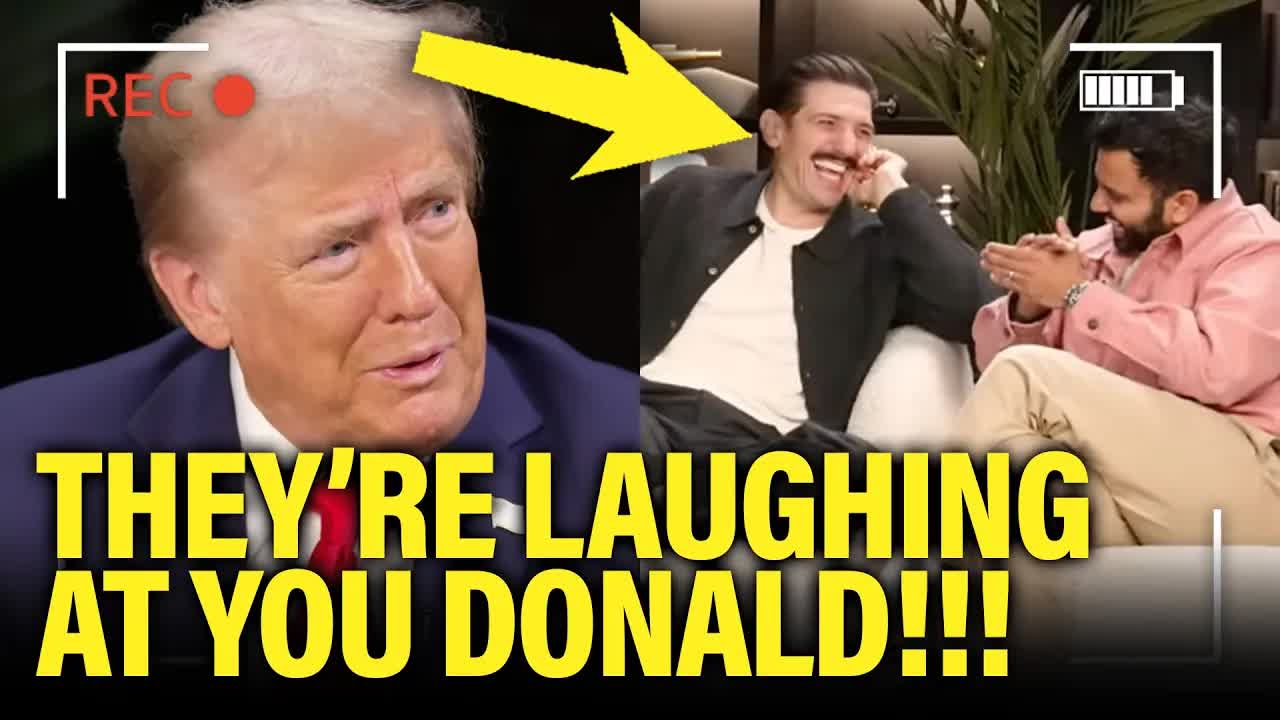
In a recent podcast episode that has left many scratching their heads, former President Donald Trump found himself the target of laughter and mockery from hosts Andrew Schultz and Akash Singh on the comedy show “Flagrant.”
The interview, intended to be a serious discussion, quickly devolved into a chaotic display of disjointed thoughts and bizarre assertions, showcasing a side of Trump that many have come to expect but few can truly fathom.
During the episode, Trump attempted to weave together a narrative about historical presidents, notably Dwight Eisenhower, while simultaneously boasting about his intelligence.
He bizarrely noted that only 8% of U.S. presidents were generals, contrasting this with the overwhelming majority being politicians.
This odd comparison seemed to serve no real purpose other than to highlight his own unique position within the political landscape, leaving listeners to wonder where he was really going with it.
Trump’s rambling style took center stage as he insisted that he was a “truthful person,” yet his claims often contradicted established facts.
At one point, he reflected on how television audiences either ignore or laugh at him, suggesting that he was somehow above the ridicule.
This self-awareness, however, did little to mitigate the absurdity of his statements, as the hosts struggled to keep a straight face while he rambled about everything from military leadership to cancer-causing windmills.
The conversation took an even more bizarre turn when Trump was pressed about the assassination attempt against him.
His response was so incoherent that he had to pause mid-sentence to clarify his own thoughts, leading to uproarious laughter from the hosts.
It was a moment that highlighted not just the absurdity of the situation but also the disconnect between Trump’s reality and that of the rest of the world.
As the discussion shifted towards his relationship with former Vice President Mike Pence, Trump expressed disappointment over Pence’s actions on January 6th.
He claimed they had a good relationship until Pence failed to act as Trump wished during the Capitol riots.
Yet, many couldn’t help but question what exactly Trump believed was the “right” course of action, given that Pence had consistently stated he acted in accordance with the Constitution.
In a particularly telling moment, Trump insisted that Pence had the right to contest electoral votes, a claim that Pence himself has openly refuted.
The former vice president has made it clear that he was under no obligation to overturn the election results, which would have set a dangerous precedent for American democracy.
Trump’s insistence on being “right” in this matter only added to the confusion surrounding his grasp of the situation.
Throughout the podcast, Trump’s rhetoric included sweeping generalizations about Democrats, branding them as “con artists” and promising to “weed them out.” Such statements, filled with bravado but lacking substance, seemed to play into a narrative that many find increasingly troubling.
The notion of political opponents being labeled as threats to democracy is not just hyperbole; it reflects a deeper division within the country.
As the interview progressed, it became evident that Trump’s understanding of the events surrounding January 6th remains deeply flawed.
His attempts to rewrite history were met with skepticism, particularly regarding the violent acts committed by supporters during the Capitol riots.
The physical and emotional toll of that day continues to resonate, with many questioning Trump’s accountability for the chaos that ensued.
Moreover, Trump’s continued insistence on falsehoods about the election results has raised alarms among political observers.
His claims of a stolen election, despite overwhelming evidence to the contrary, not only undermine public trust but also threaten the very fabric of democracy itself.
The potential ramifications of such rhetoric are serious, as it encourages a culture of denial and divisiveness.
This interview comes on the heels of Trump’s team criticizing Vice President Kamala Harris for her podcast appearances, highlighting a glaring inconsistency in his own media choices.
While he derides others for engaging in informal discussions, he willingly participates in a less popular podcast, raising questions about his motives and message.
As Trump continues to navigate the political landscape, his words carry weight—whether he acknowledges it or not.
The impact of his rhetoric can shape opinions, influence elections, and ultimately affect the lives of millions.
With the stakes higher than ever, the need for responsible leadership and honest discourse is paramount.
In the end, the podcast appearance serves as a reminder of the complexities and challenges facing American politics today.
As the nation grapples with division and distrust, the importance of integrity and truth in leadership cannot be overstated.
The road ahead may be fraught with obstacles, but a commitment to democratic principles and accountability will be essential for healing and progress.
Read more
