



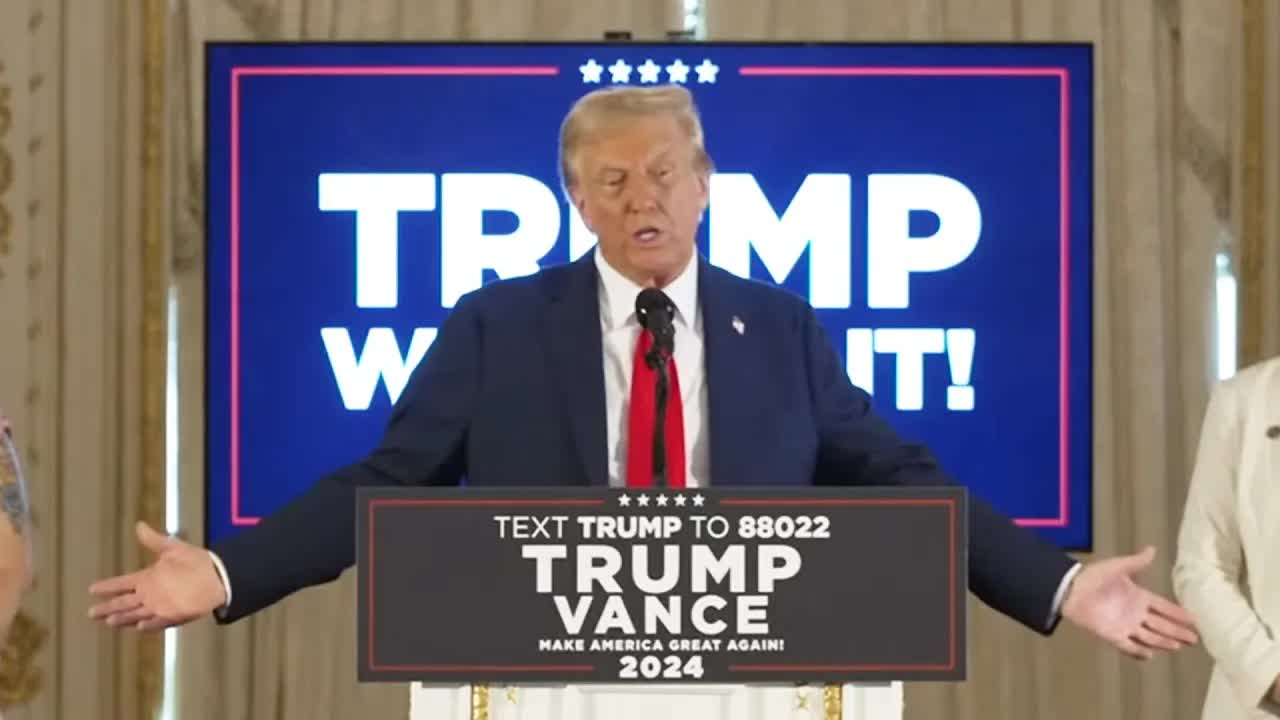
In a recent press conference at his Palm Beach residence, Donald Trump left many scratching their heads.
Arriving an hour late to an event held at his own home, the former president’s presentation was marked by a familiar pattern of provocative remarks and a glaring absence of interaction with the audience.
The event, intended to be a platform for questions and answers, quickly devolved into a monologue where Trump took aim at Michelle Obama.
He described her as “nasty” for her criticisms, which he interpreted as a personal affront.
Trump’s use of the term “nasty” is noteworthy; it seems reserved primarily for women who challenge him, suggesting a troubling double standard in his rhetoric.
In his remarks, Trump reminisced about a previous encounter with the former First Lady, claiming she had been disrespectful.
His narrative painted a picture of a defensive Trump, one who perceives any opposition from women as hostility.
This dynamic raises a question: when did disagreement become synonymous with being “nasty”?
As the press conference progressed, Trump made headlines with a shocking statement regarding immigration policy.
He suggested that if he were to reclaim the presidency, he would target legal immigrants for deportation.
This assertion is alarming, particularly given that many of those he referred to have legal status in the U.S. under temporary protected status—a designation established long before his administration.
Trump’s comments about Ohio also drew scrutiny.
He claimed that the state had seen an influx of “illegal aliens,” despite the fact that many Haitian immigrants there are legally residing in the country.
This conflation of legal and illegal statuses serves to mislead the public and stoke fear around immigration issues, a tactic Trump has employed repeatedly.
Moreover, Trump’s historical inaccuracies about immigration policies are concerning.
The framework for temporary protected status has existed since the early 1990s, and attributing its implementation solely to Democratic leaders is misleading.
Such statements reflect a broader pattern where Trump seems willing to rewrite history to fit his narrative.
In a bizarre twist, Trump attempted to draw parallels between his recent events and past gatherings, even referencing the infamous Nazi rally at Madison Square Garden in 1939.
He claimed that his recent event was filled with “love,” contrasting it with the historical context of hate associated with that venue.
This juxtaposition not only trivializes the gravity of history but also reveals a troubling disconnect from reality.
His description of the Madison Square Garden event as a “love fest” stands in stark contrast to the actual atmosphere, which many observers characterized as divisive and hostile.
The former president’s insistence on framing these gatherings in such a positive light raises eyebrows and invites skepticism about his grasp on the current political climate.
As Trump concluded his press conference—without taking any questions—it became evident that he was not engaging with the media or the public in any meaningful way.
Instead, he delivered a tired performance that seemed more about self-aggrandizement than addressing pressing issues facing the nation.
Observers noted Trump’s visible fatigue and lack of coherence, prompting concerns about his ability to lead effectively.
Comparisons between his past and present performances highlight a noticeable decline in energy and clarity, leaving many to wonder if he is fit for the demands of high office.
Looking ahead, the implications of a potential Trump presidency raise significant concerns.
With figures like J.D.
Vance potentially wielding considerable influence, the specter of a leadership style that echoes Trump’s controversial tactics looms large.
As the political landscape continues to evolve, it’s crucial to critically assess the messages and strategies employed by candidates like Trump.
The need for informed discourse has never been more pressing, especially as we navigate the complexities of immigration, gender dynamics, and political rhetoric in today’s society.
Read more
