
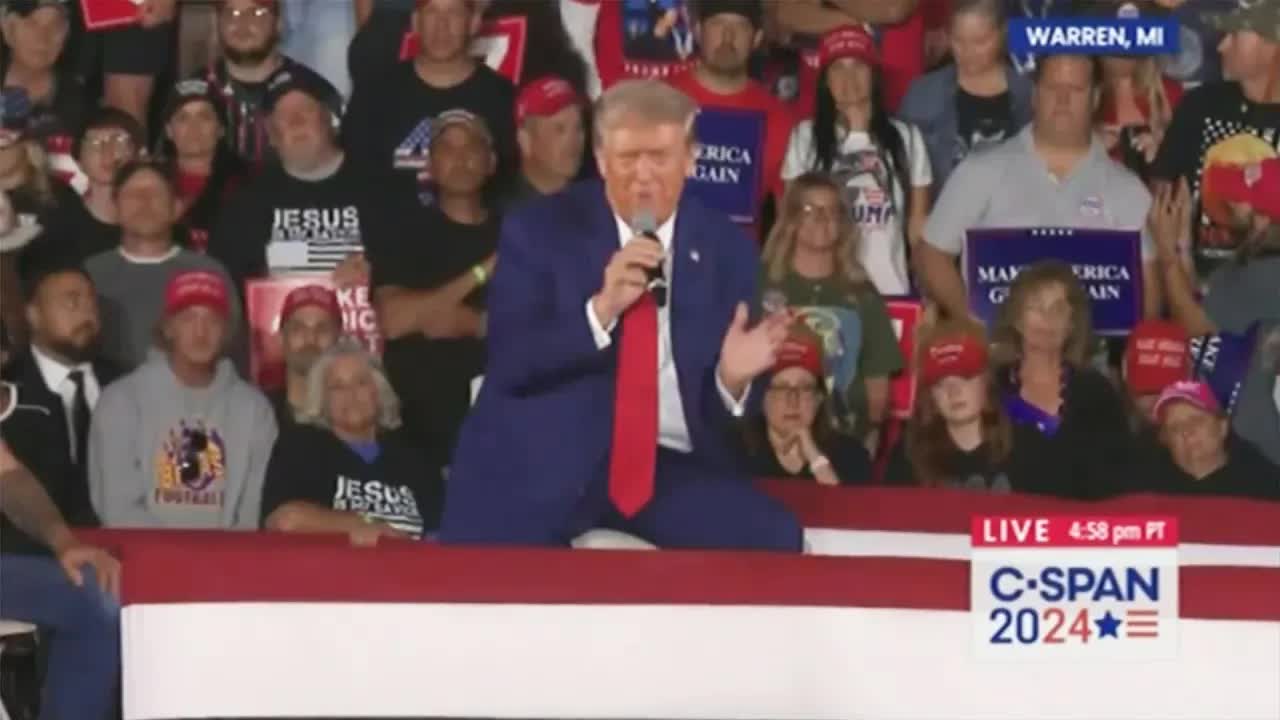
At a recent campaign event in Warren, Michigan, Donald Trump found himself in a familiar situation—attempting to respond to audience questions.
However, his efforts quickly spiraled into a humorous exchange that left many scratching their heads.
The question posed was straightforward: what would he do to keep jobs in the United States, particularly to ensure that Michigan continues to produce the best cars in the world?
Yet, deciphering Trump’s response proved to be a challenge.
Instead of addressing the query directly, Trump took a detour into his own narrative, reminiscing about an alleged honor he received years ago as “man of the year.”
It’s worth noting that this accolade appears to be a fabrication; no such award exists, and many have debunked Trump’s claim.
His instinct to pivot the conversation back to himself overshadowed the actual topic at hand.
As he continued, Trump insisted that the supposed award was real, despite the overwhelming evidence to the contrary.
He claimed that the “fake news” had dismissed the honor, yet he remained adamant that it did occur.
This kind of self-centered storytelling is not new for Trump, who often seems to prioritize his personal experiences over responding to pressing issues.
When pressed further on how he plans to retain jobs in America, Trump veered off course again, discussing the decline of the car industry without offering concrete solutions.
Instead of providing a strategic plan, he lamented the loss of jobs and attempted to rally the crowd against the media present at the event.
This tactic of deflecting blame onto journalists is a hallmark of his speaking style.
In a surprising twist, Trump brought up President McKinley, illustrating his point about tariffs with a historical reference that felt disjointed and confusing.
He suggested that America thrived under a system of tariffs during McKinley’s presidency, but his grasp of economic principles seemed tenuous at best.
The connection he attempted to draw between past tariffs and current job retention fell flat, leaving many to wonder about his understanding of the issues.
One striking observation from the event was Trump’s apparent disinterest in engaging with the audience.
As he rambled on, he seemed distracted, struggling to maintain focus on the questions being asked.
This behavior has led some experts to speculate about potential attention issues, hinting that he might benefit from proper management of any underlying conditions.
It’s not just a matter of personal shortcomings; Trump’s lack of genuine concern for the audience’s questions was palpable.
He appeared to believe that winning the crowd’s support did not hinge on addressing their specific concerns.
This disconnect raises questions about his commitment to the very voters he seeks to rally behind his campaign.
In stark contrast, Vice President Kamala Harris enjoyed a more productive weekend filled with successful rallies and engagement with her supporters.
While Trump floundered with vague references and self-aggrandizing tales, Harris seemed to connect more authentically with her audience, emphasizing her dedication to addressing their needs.
As the political landscape continues to shift, the contrasting styles of these two figures highlight the different approaches they take to campaigning.
Harris’s ability to resonate with voters stands in sharp relief to Trump’s tendency to focus on himself rather than the issues at hand.
The aftermath of Trump’s Michigan event leaves us pondering the effectiveness of his campaign strategy.
With the election season heating up, voters are likely to scrutinize candidates not only on their promises but also on their ability to engage meaningfully with the electorate.
Looking ahead, it remains to be seen how both candidates will adapt their messaging and tactics as they vie for public support.
Will Trump refine his approach, or will he continue down the path of self-referential anecdotes?
Only time will tell as the race unfolds.
Read more
