

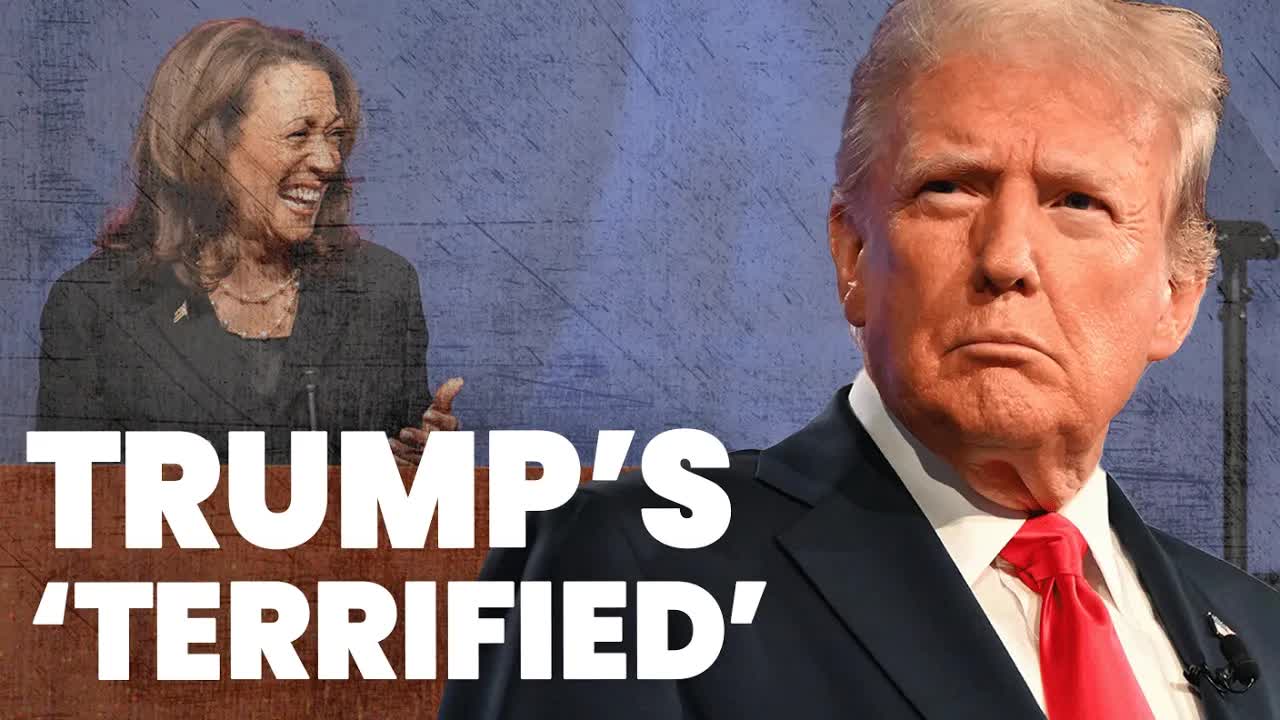
The political landscape is buzzing as former President Donald Trump’s campaign faces unprecedented challenges.
An assassination attempt at a recent rally has left many questioning his stability and mental acuity.
Observers note that Trump appears to be in cognitive decline, seeming less sharp than in previous years—though he was never known for his intellectual prowess to begin with.
Recent reports indicate a significant shift within the Republican Party, with a record 17% of its members crossing over to support Vice President Kamala Harris.
This trend raises eyebrows about Trump’s campaign viability.
Ryan, a political analyst, argues that while Trump’s core base remains intact, this shift could indicate trouble ahead.
The endorsements from what he calls “sane Republicans” are aimed at swaying the undecided voters, often referred to as “squishy Republicans,” who typically lean Republican but don’t fully align with the MAGA movement.
Despite these endorsements, Trump’s loyal followers show no signs of wavering.
They remain steadfast, akin to a cult following that holds its leader in unwavering devotion.
However, the atmosphere at Trump HQ is reportedly chaotic, especially as election day approaches.
With Harris actively campaigning and engaging in hurricane relief efforts, Trump’s absence on the trail has become glaringly apparent.
Why has Trump reduced his public appearances?
Analysts suggest fear may be a driving factor.
The recent assassination attempt seems to have rattled him, and concerns about his cognitive abilities are growing.
Trump’s reliance on J.D.
Vance, a younger candidate, suggests a strategic shift; Vance embodies the MAGA ethos while presenting a more palatable face to the electorate.
His ability to communicate effectively contrasts sharply with Trump’s increasingly erratic speeches.
As Trump retreats to Mar-a-Lago, the question arises: can he win an election from behind closed doors?
Many believe he’s not banking on a fair election process.
Instead, Trump seems to be preparing for potential electoral shenanigans, reminiscent of his attempts in 2020.
The political climate suggests he might rely on intimidation tactics and legislative maneuvering to sway results in his favor.
Reports from the New York Times highlight a troubling trend: Trump’s speeches are becoming angrier and more disjointed.
This has led to speculation that his campaign team is limiting his public speaking engagements to avoid further gaffes.
The chaos within his campaign is palpable, with rumors of discord among staff members surfacing frequently.
At a recent rally, Trump expressed frustration when a photo displayed did not match the crowd size he boasted about.
His public outbursts against his own team signal deeper issues within the campaign structure.
Observers liken the current state of the Republican Party to a dying star, consuming its energy rapidly before collapsing in on itself.
The Democratic Party, on the other hand, appears united under a broad umbrella, welcoming a diverse coalition of voices.
The stark contrast between the two parties raises questions about the future of American politics.
As the election approaches, voters face a critical choice: align with Trump’s divisive rhetoric or embrace the inclusive message of candidates like Harris.
Looking ahead, the Republican Party may be facing an existential crisis.
Some analysts predict it could follow the path of the Whig Party, which faded into obscurity.
There are voices within the party, such as Liz Cheney and Adam Kinzinger, advocating for a return to traditional conservative values, but the grip of the MAGA movement complicates any potential transformation.
Recent revelations about Trump’s connections with Putin, including sending COVID tests and multiple phone calls post-presidency, have added fuel to the fire.
However, the impact of this information on his voter base remains uncertain.
Many of Trump’s supporters are characterized as low-information voters, often disconnected from mainstream media narratives.
As Trump’s cognitive decline becomes increasingly noticeable, the dynamics at his rallies are shifting.
Reports of attendees leaving early raise questions about their engagement levels.
While many still support him, the entertainment value of his speeches may be waning, replaced by a sense of sadness over his decline.
In this tumultuous political climate, the future remains uncertain.
Will the Republican Party evolve, or will it continue to spiral into chaos?
Only time will tell if the party can find a way to unite under a banner that resonates with a broader audience, or if it will succumb to the internal strife that currently threatens its very existence.
Read more
