








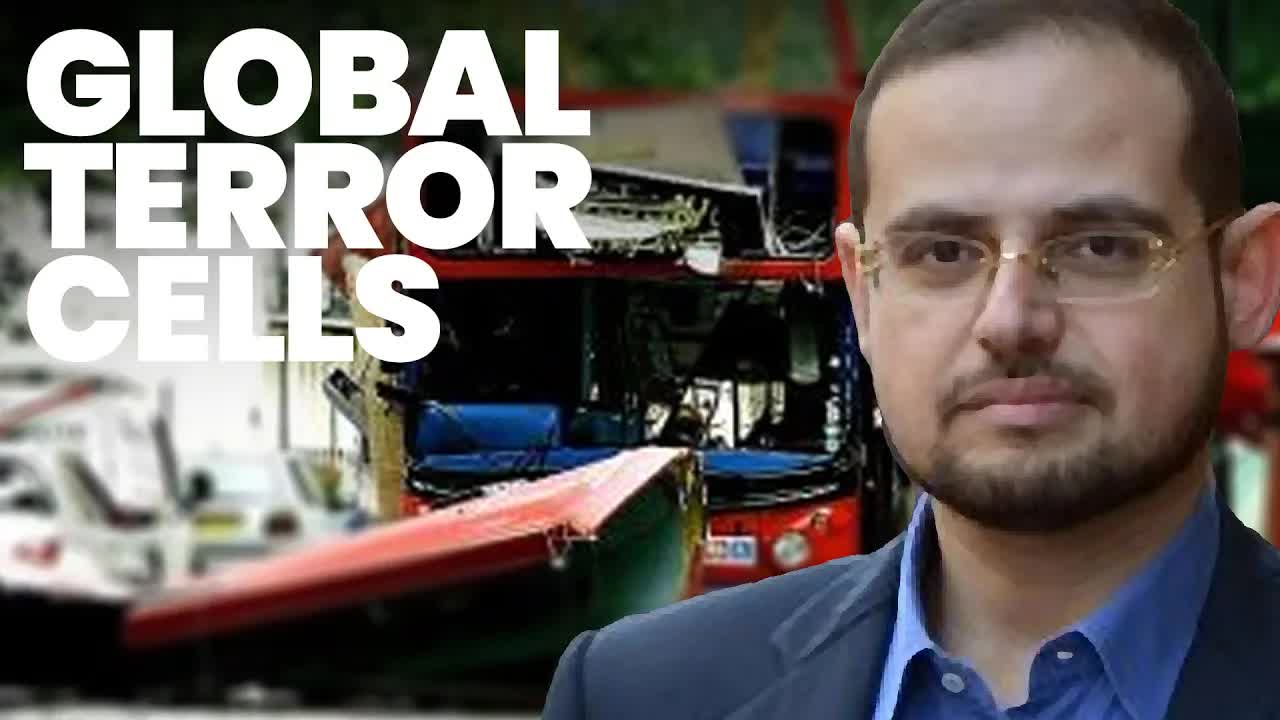
Hezbollah’s influence is stretching far beyond its Lebanese roots, with cells reportedly operating across Latin America, West Africa, and even Eastern Europe.
This alarming trend has raised concerns among intelligence agencies, particularly in the UK, where threats from groups like Hezbollah, al-Qaeda, and the Islamic State are on the rise.
The interconnectedness of these terrorist organizations poses a significant risk, as evidenced by past attacks and ongoing plots.
In a recent discussion, MI5’s Director General Ken McCallum shed light on the current state of terrorism.
He revealed that since 2017, British intelligence has thwarted 43 late-stage terrorist plots.
With the resurgence of conflict in the Middle East, particularly the ongoing Palestine-Israel tensions, there’s a growing fear that such violence could spill over into the UK.
McCallum expressed that these mass murder plots are what keeps him awake at night.
Eamon Dean, a former al-Qaeda member turned MI6 agent, provided insight into the cyclical nature of terrorism.
According to Dean, history shows that each new conflict tends to reignite the flames of extremism.
He likened this pattern to the phases of the moon, where periods of relative calm are often followed by renewed violence.
From Afghanistan in the late 20th century to the current upheaval in the Middle East, each conflict serves as a recruitment tool for terrorist organizations.
Dean pointed out that the narrative surrounding these conflicts often fuels recruitment efforts.
When tensions flare in the Middle East, extremist groups exploit the situation, framing it as a battle between the West and Islam.
This twisted perspective resonates with disillusioned youth, who may feel compelled to act in defense of the Palestinian cause, often without fully understanding the broader implications of their actions.
The potential for active terrorist cells within the UK is troubling.
Dean noted that back in 2017, there were already around 3,000 individuals of interest linked to these organizations.
Given the events that have transpired since then, including the rise of Hezbollah’s global presence, the threat level has likely escalated significantly.
He emphasized that if Hezbollah were to activate its international network, the challenges for UK security forces would multiply exponentially.
Hezbollah’s reach is extensive, with cells reported in various regions, including South America and parts of Africa.
Dean highlighted past incidents, such as the 1992 and 1994 Buenos Aires bombings attributed to Hezbollah, as well as a foiled attack in London just two years ago.
These examples illustrate the group’s willingness and capability to target Western interests, particularly those linked to Israel.
Iran’s role in Hezbollah’s operations cannot be understated.
Dean suggested that the group often requires Iranian approval to mobilize its global networks, especially during times of heightened tension.
As Hezbollah faces pressure in Lebanon, it may resort to activating its cells to send a clear message to the West regarding its nuclear ambitions.
Understanding the motivations behind radicalization is crucial.
Dean shared insights from his years spent undercover with young jihadists, revealing that many are drawn in by eschatological beliefs.
They are often led to believe they are part of a divine plan, fighting in a cosmic battle foretold in religious texts.
This sense of purpose can be incredibly compelling, especially for those feeling disenfranchised or powerless.
The head of MI5 acknowledged the daunting challenge ahead, stating he has, “one hell of a job on his hands.”
However, Dean expressed confidence in the capabilities of British intelligence.
While he noted that resources may not match those of their American counterparts, he praised the professionalism and deep understanding of the core issues faced by UK security services.
As the landscape of terrorism evolves, vigilance remains paramount.
The interconnectedness of these extremist groups and their ability to exploit global conflicts underscores the need for robust counterterrorism strategies.
The fight against terrorism is complex, requiring cooperation among nations and a nuanced understanding of the underlying factors that drive individuals toward extremism.
The conversation around these threats continues to be critical, and experts like Eamon Dean play an essential role in illuminating the challenges ahead.
As the world grapples with rising extremism, staying informed and aware of these dynamics is more important than ever.
Read more
