







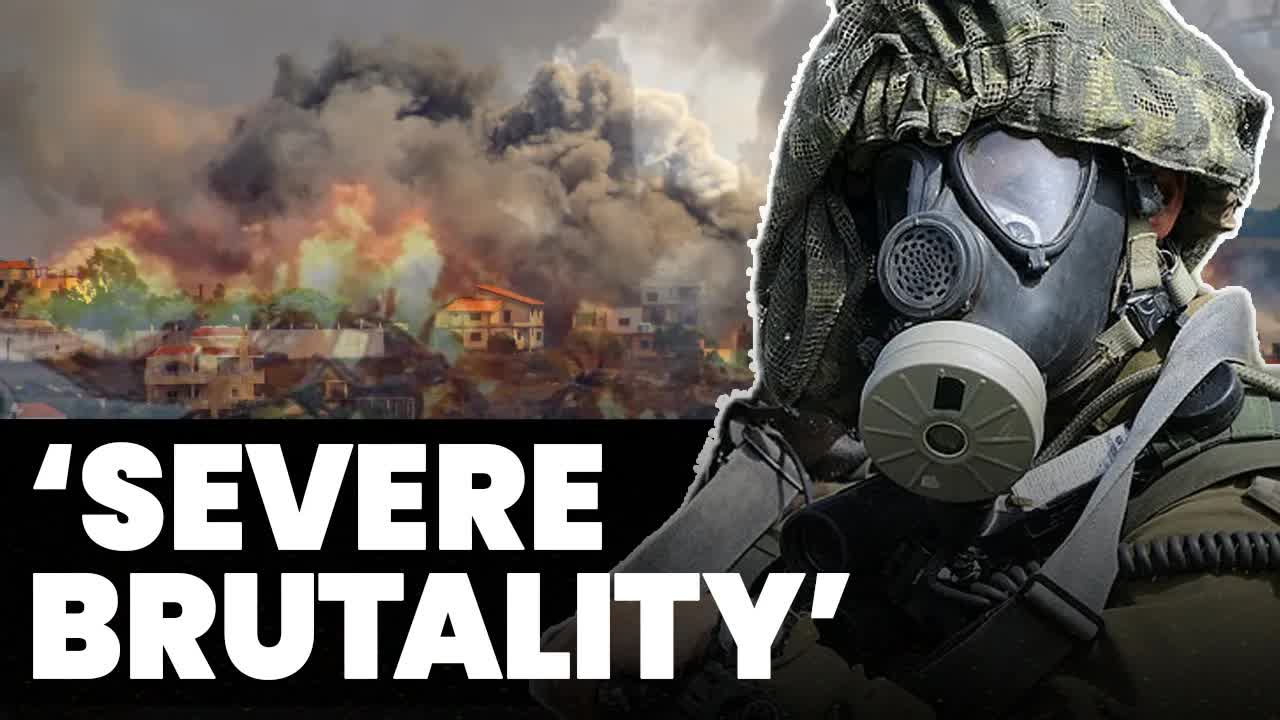
In a dramatic escalation of violence, the Israeli government has intensified its military operations against Hezbollah in Lebanon, raising alarms across the region.
The ongoing airstrikes, described by watchdog group Airwars as the most aggressive aerial campaign seen in two decades outside of Gaza, have left Lebanon grappling with severe humanitarian crises and renewed fears of broader conflict.
Rami Mortada, Lebanon’s ambassador to the UK, painted a grim picture of the situation on the ground during a recent interview.
He described relentless airstrikes that spare neither civilians nor critical medical facilities, a tactic reminiscent of Israel’s previous operations in Gaza.
Mortada emphasized that the brutality of these attacks reflects a troubling pattern in Israel’s military strategy, where the suffering of innocent lives is often overshadowed by political ambitions.
When asked about Hezbollah’s role in this conflict, Mortada acknowledged the complexity of the group’s presence in Lebanon.
He stated that while Hezbollah is woven into the social fabric of the country, opinions on its actions vary widely among the Lebanese populace.
Some support the group’s resistance against Israeli aggression, while others advocate for a more inclusive dialogue to address the grievances that fuel Hezbollah’s existence.
The ambassador highlighted a critical issue: the Lebanese government’s capacity to rein in Hezbollah.
While he affirmed that the government could theoretically intervene, he stressed that any effective action must be part of a broader, symmetrical approach that considers Israel’s continued occupation and provocations.
Mortada argued that without addressing these underlying issues, efforts to limit Hezbollah’s actions would be futile.
Mortada also pointed out that the Lebanese government officially adheres to UN Resolution 1701, which calls for a ceasefire and a peaceful resolution to the conflict.
However, he criticized Israel for repeatedly violating this resolution through airspace incursions and military operations, complicating Lebanon’s ability to maintain stability and security.
As tensions rise, questions about the path to peace become increasingly urgent.
Mortada proposed that a genuine solution requires open dialogue and a ceasefire agreement involving all parties.
He noted a joint statement from over 15 nations advocating for a 21-day ceasefire, followed by serious discussions on mutual grievances.
Yet, he lamented that this proposal was quickly dismissed by Israeli Prime Minister Netanyahu at the UN General Assembly.
The ambassador also addressed the contentious issue of Iranian influence in the region.
While he refrained from commenting directly on Iran’s actions, he underscored the need for de-escalation and cautioned against dragging Iran further into the conflict.
The region, he noted, is already a powder keg, and provocative actions only serve to heighten tensions.
Reflecting on the historical context of the conflict, Mortada urged a comprehensive understanding of events leading up to the current crisis.
He pointed out that while the horrors of October 7th are undeniable, they should not eclipse the broader narrative of ongoing violence and oppression faced by Palestinians, which has been a persistent issue long before that date.
Despite the complexities, Mortada maintained that Israel’s right to self-defense is not absolute.
He condemned the killing of thousands of Palestinians and the destruction of infrastructure as disproportionate responses that violate international law.
He called for accountability and a recognition that both sides must engage in a symmetrical approach to achieve lasting peace.
In addressing the existence of Israel, Mortada reiterated the Arab Peace Initiative established in 2002, which offers normalization of relations contingent upon Israel’s withdrawal from occupied territories and the establishment of a sovereign Palestinian state.
He affirmed that the two-state solution remains the only viable path forward, dismissing any alternative proposals as inadequate.
Ultimately, Mortada’s message to Netanyahu was one of frustration and urgency.
He urged the Israeli leader to reconsider his approach, warning that the ongoing violence only sows seeds for future conflict and instability.
As the region stands on the brink of further escalation, the call for a just and comprehensive peace grows louder, echoing the hopes of countless individuals yearning for an end to the cycle of violence.
Read more
