









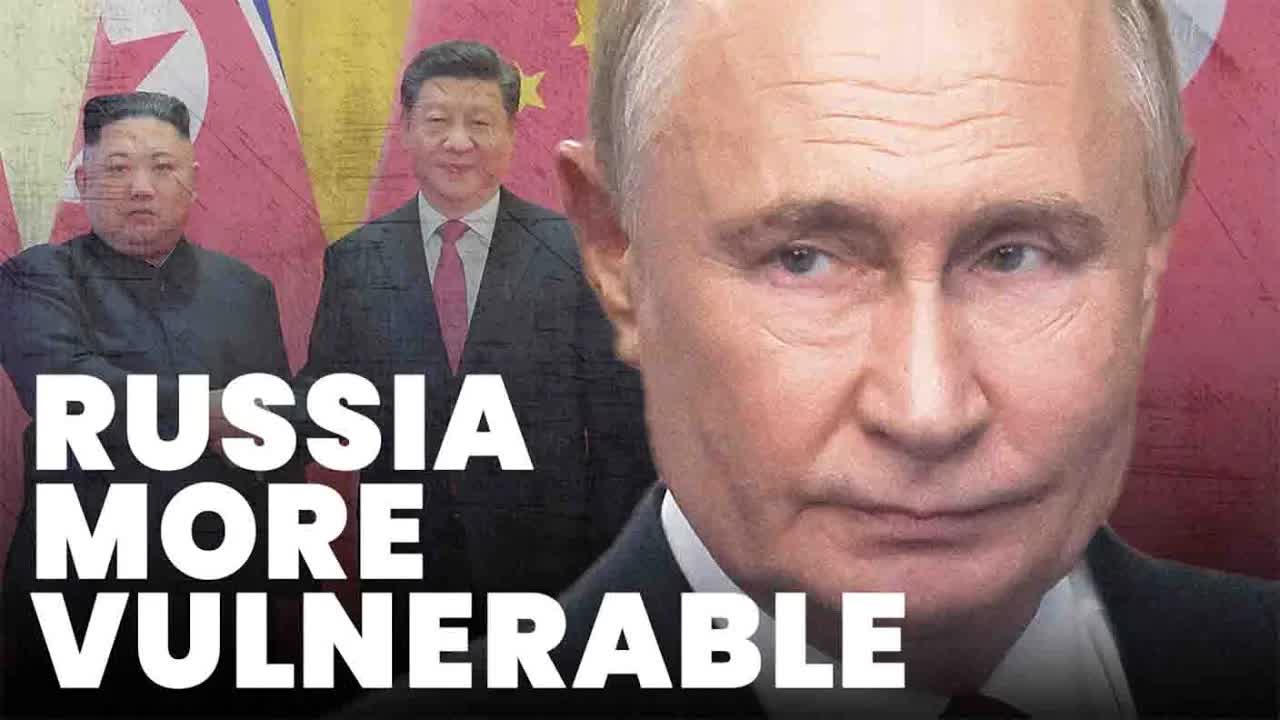
As the geopolitical landscape continues to shift, President Vladimir Putin finds himself in a precarious position.
Despite hosting world leaders at the recent BRICS summit in Russia, where he aimed to project strength and leadership of an anti-Western alliance, the reality is far more complex.
His reliance on allies like North Korea and China raises questions about his true power and the cost of these partnerships.
Recent reports indicate that North Korean troops, numbering between 3,000 to 12,000, are now reportedly engaged in combat within Ukraine.
These soldiers are drawn from one of North Korea’s more elite army corps, suggesting they may possess greater discipline than the average conscript.
However, it’s important to note that they are not special forces.
Their deployment could either bolster Russian efforts directly on the battlefield or allow Russian troops to be reassigned to more critical roles.
While Ukrainian officials claim to have seen North Korean forces in action, U.S. intelligence remains cautious, suggesting that these troops are still undergoing training in the Russian Far East.
Regardless of their current status, the involvement of North Korean soldiers signifies a shift in the dynamics of the ongoing conflict, with implications for both Russia and Ukraine.
Behind the scenes, the relationship between Russia and North Korea is transactional.
North Korea is not offering its support without expecting something in return.
Reports suggest that the North Koreans are receiving food, military equipment, and even technology from Russia.
This exchange underscores the reality that Putin must pay a steep price for any assistance he garners, raising concerns about the long-term ramifications of these alliances.
At the BRICS summit, Putin may have appeared to command a coalition of nations willing to assist him, yet this perception is misleading.
The optics of the event masked the underlying truth: any perceived benefits come at a significant cost.
China’s growing influence in the partnership only complicates matters, as Russia finds itself increasingly dependent on its larger neighbor.
Moreover, the technology that North Korea receives from Russia is likely a one-time deal, which limits the strategic advantage it could provide in the future.
Iran’s engagement with Russia further exemplifies this trend.
While Iran has supplied drones and missiles, it has also leveraged its position to shift Russia’s foreign policy, particularly concerning Israel and groups like Hezbollah.
This intricate web of alliances leaves Russia vulnerable.
Although these partnerships enable Putin to continue his military campaign in Ukraine, they also create dependencies that could haunt Russia in the long run.
The Kremlin’s willingness to compromise its relationships with former allies in pursuit of short-term gains is a gamble that may not pay off.
The implications of these decisions extend beyond Putin’s current presidency.
The sacrifices made today could lead to a weakened Russia, isolated from traditional allies and under the thumb of more dominant partners like China.
Putin’s focus appears singularly fixed on the war in Ukraine, perhaps blinding him to the broader consequences of his actions.
An insightful observation from Professor Mark Gagliotti highlights a crucial aspect of Putin’s mindset.
He suggests that the Russian leader may not fully grasp that discontent with the West does not equate to support for Russia.
This disconnect raises questions about the information Putin receives, echoing the flawed intelligence that led to the disastrous initial invasion of Ukraine.
The Kremlin’s narrative may be crafted to reinforce Putin’s self-image as a strong leader, but the reality could be quite different.
If his advisors are merely echoing what he wants to hear, the potential for miscalculation grows.
Rational actors can make poor decisions when they operate within a bubble of misinformation.
As the situation unfolds, the arrival of North Korean troops in Ukraine is emblematic of Putin’s precarious balancing act.
While he seeks to project strength and unity among his allies, the underlying vulnerabilities of these partnerships may ultimately undermine his position.
The stakes are high, and the outcome remains uncertain as the conflict continues to evolve.
Read more
