


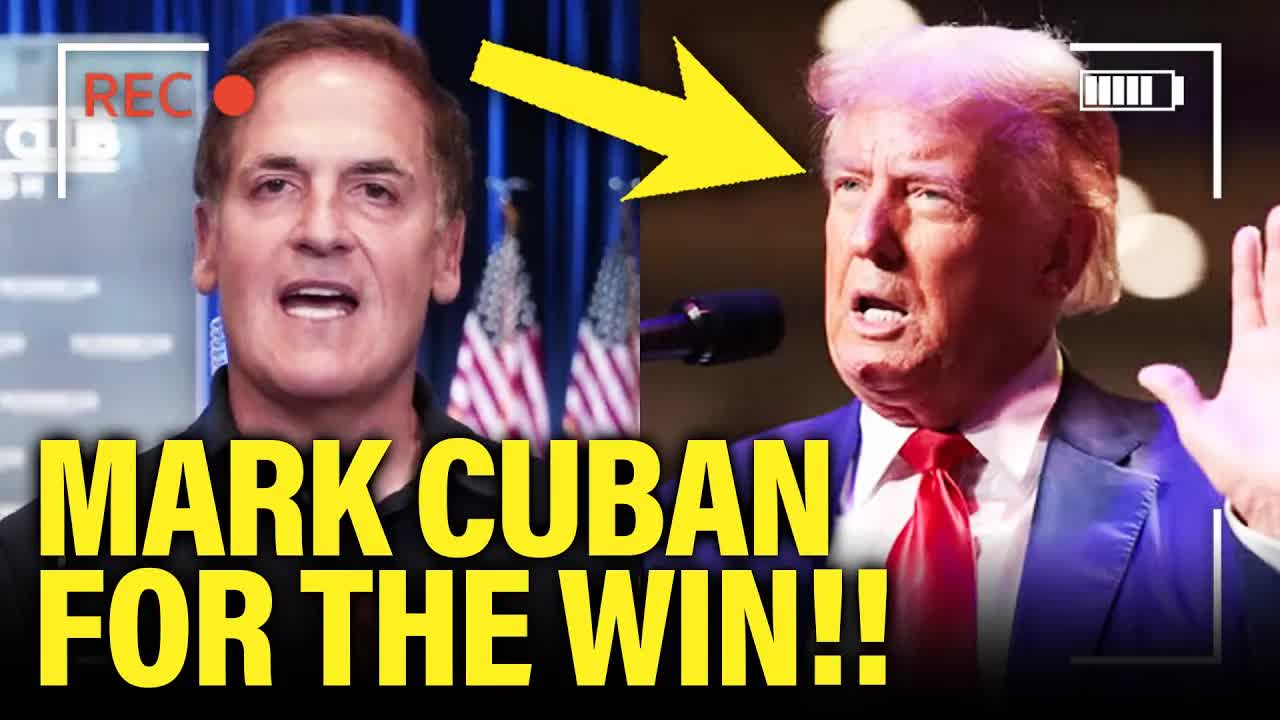
In a series of bold appearances on various media platforms, billionaire entrepreneur Mark Cuban has been vocally challenging Donald Trump’s economic policies, igniting a firestorm of discussion.
Cuban’s critiques are not just casual observations; they represent a significant shift in the narrative surrounding Trump’s business acumen, especially coming from someone who knows the business world intimately.
With Cuban’s insights, it appears that Trump may have a new adversary in the realm of economic discourse.
Recently, Cuban appeared on Fox News, where he described Trump’s economic strategies as “insane.” He elaborated on the detrimental effects of broad tariffs, stating that they impose unnecessary costs on American consumers.
Cuban pointed out that while strategic tariffs can be beneficial when dealing with unfair trade practices, blanket tariffs of 10% to 20% are merely inflationary.
This perspective positions Cuban as a voice of reason amidst the chaos of political rhetoric.
The conversation took an interesting turn when Cuban compared Trump’s impulsive policy announcements to Vice President Kamala Harris’s methodical approach.
He praised Harris for her thoroughness and attention to detail, suggesting that her campaign operates more like a well-run corporation than a chaotic rally.
Cuban emphasized that Harris’s proposals are carefully vetted, in stark contrast to Trump’s often erratic declarations that leave his supporters scrambling to interpret his meaning.
During his critique, Cuban highlighted a specific instance where Trump threatened John Deere with a staggering 200% tariff if the company moved manufacturing to Mexico.
Cuban argued that such threats not only harm American companies but also give an advantage to foreign competitors.
This kind of rhetoric, he asserts, is the epitome of poor business strategy and illustrates Trump’s lack of understanding of global markets.
Cuban didn’t stop there.
He also lauded Harris’s recent economic event in Pittsburgh, where she articulated a vision for faster project completion in the U.S.
According to Cuban, her ability to turn around her campaign’s fortunes in a matter of weeks demonstrates her leadership skills—skills he believes would translate well into her presidency.
He painted a picture of Harris as someone who understands the intricacies of running a successful organization, making her a formidable candidate.
The billionaire’s critiques extended to Trump’s approach to business support, particularly for small enterprises.
Cuban pointed out that while Trump has focused on larger corporations, he has largely neglected the needs of small businesses—the backbone of the American economy.
In contrast, he noted that Harris has consistently advocated for policies that would empower entrepreneurs and facilitate business growth across all sectors.
Cuban’s remarks resonate with many in the business community who feel overlooked by Trump’s administration.
By focusing on issues like child tax credits and support for startups, Harris has positioned herself as a champion for small businesses.
Cuban believes this approach is essential for fostering innovation and economic stability in the United States.
Moreover, Cuban’s commentary on Trump’s proposed 20% tariff on imports reveals a deeper concern about the implications of such policies.
He argues that this blanket taxation would act as a national sales tax, ultimately burdening consumers and small businesses alike.
Cuban’s insistence on the need for strategic tariffs rather than sweeping measures underscores his commitment to sensible economic policy.
In a recent CNN interview, Cuban further elaborated on the socialist undertones of some of Trump’s proposals, suggesting that they mirror the very policies Trump accuses Harris of promoting.
He pointed out that Trump’s suggestion to cap credit card interest rates is fundamentally a form of price control—an irony that hasn’t gone unnoticed in the political landscape.
As Cuban continues to speak out against Trump, his growing influence in the media spotlight highlights a critical dialogue about economic leadership in America.
His willingness to challenge a former president’s policies reflects a broader sentiment among business leaders who are increasingly concerned about the direction of the economy.
With each appearance, Cuban reinforces the notion that informed business practices and sound economic policies are crucial for the nation’s future.
His critiques not only serve to elevate the discourse around economic strategies but also challenge voters to consider the implications of their choices in the upcoming elections.
As the political landscape evolves, the insights of successful business figures like Mark Cuban will undoubtedly play a pivotal role in shaping public opinion and influencing policy discussions.
The ongoing debate over economic policies will likely continue to heat up, with Cuban at the forefront, ready to hold leaders accountable for their decisions.
Read more
