

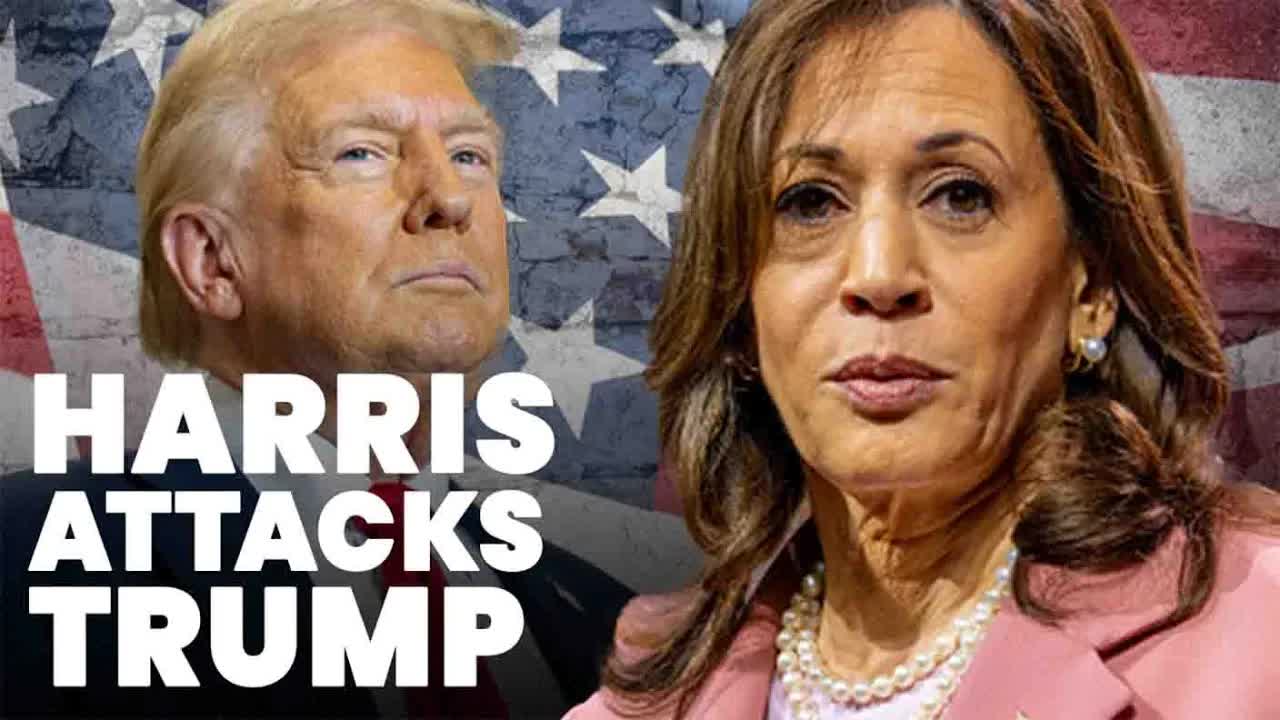
In a striking statement that has sent ripples through the political landscape, U.S. Vice President Kamala Harris has labeled former President Donald Trump a fascist seeking unchecked power.
This assertion comes in the wake of comments made by John Kelly, Trump’s former chief of staff and a retired four-star general, who disclosed that Trump expressed a desire for military leaders akin to those of Adolf Hitler.
This revelation raises serious concerns about Trump’s vision for military loyalty, which seems to prioritize personal allegiance over fidelity to the Constitution.
During a recent discussion, Harris emphasized that Trump’s intent is not to foster a military that serves the nation but rather one that serves him personally.
This alarming perspective suggests a willingness to disregard constitutional duties in favor of personal vendettas.
Over the past week, Trump has openly referred to fellow Americans as “the enemy from within,” indicating that anyone who challenges or criticizes him—such as judges, journalists, and impartial election officials—falls into this category.
Harris’s remarks are particularly poignant considering the historical context of invoking Hitler’s name.
The atrocities committed under Nazi rule, including the genocide of six million Jews, serve as a stark reminder of the dangers of unchecked power.
By drawing parallels between Trump’s rhetoric and fascist ideologies, Harris aims to illuminate the true nature of his character, as described by those who have worked closely with him.
John Kelly’s insights provide a revealing glimpse into Trump’s mindset, suggesting he embodies characteristics commonly associated with fascism.
He has been accused of attempting to position himself as a dictator, ready to utilize the military for personal agendas.
As the election approaches, the implications of these statements become increasingly significant, especially considering that key figures who once acted as checks on Trump’s impulses may not be present should he secure a second term.
As the campaign heats up, Harris appears to be strategically focusing her efforts on attacking Trump’s character.
Polls indicate that Trump currently leads on critical issues such as the economy and border security, prompting Harris to pivot discussions back to Trump’s troubling tendencies whenever possible.
This tactic was evident during a recent CNN town hall, where she consistently redirected questions regarding economic policies back to Trump’s character flaws.
In response, Team Trump has launched counterattacks against both Kelly and Milley, the former Chairman of the Joint Chiefs of Staff, who have also criticized Trump’s behavior.
They argue that Harris is evading pressing issues central to the election, such as the economy and immigration.
Trump has vehemently denied making any statements regarding admiration for Hitler, which is a typical defensive maneuver for him.
Meanwhile, a recent Times poll reveals that 27% of Americans fear a potential civil war following the upcoming election.
This sentiment is relatively new; two decades ago, such thoughts were rarely entertained.
The heightened rhetoric from both sides has contributed to an atmosphere of uncertainty, as Trump continues to question election integrity, raising alarms about the peaceful transfer of power—a cornerstone of American democracy.
The specter of January 6, 2021, looms large in the minds of many, serving as a reminder of how volatile the political climate can become.
The fear of violence erupting post-election is palpable, although experts doubt that widespread chaos will ensue.
Nevertheless, the anxiety surrounding the electoral process underscores a growing divide in the nation.
Additionally, the involvement of Labour Party politicians and activists from the UK campaigning for Democrats has stirred some controversy.
However, it seems to be garnering more attention across the pond than in the U.S. itself.
Many in Trump’s circle appear unaware of the situation, indicating that it may not significantly impact American voters.
This situation highlights ongoing concerns about election integrity and foreign influence in U.S. politics.
As campaigns navigate the complexities of these issues, the focus remains on whether the election process can withstand external pressures and maintain its integrity.
The coming weeks will be pivotal as both campaigns ramp up their strategies.
With Harris honing in on character attacks and Trump’s team pushing back fiercely, the stage is set for what promises to be a contentious and revealing election cycle.
Each side is gearing up for battle, and the American public is left to ponder what the future holds for their democratic ideals.
Read more
