
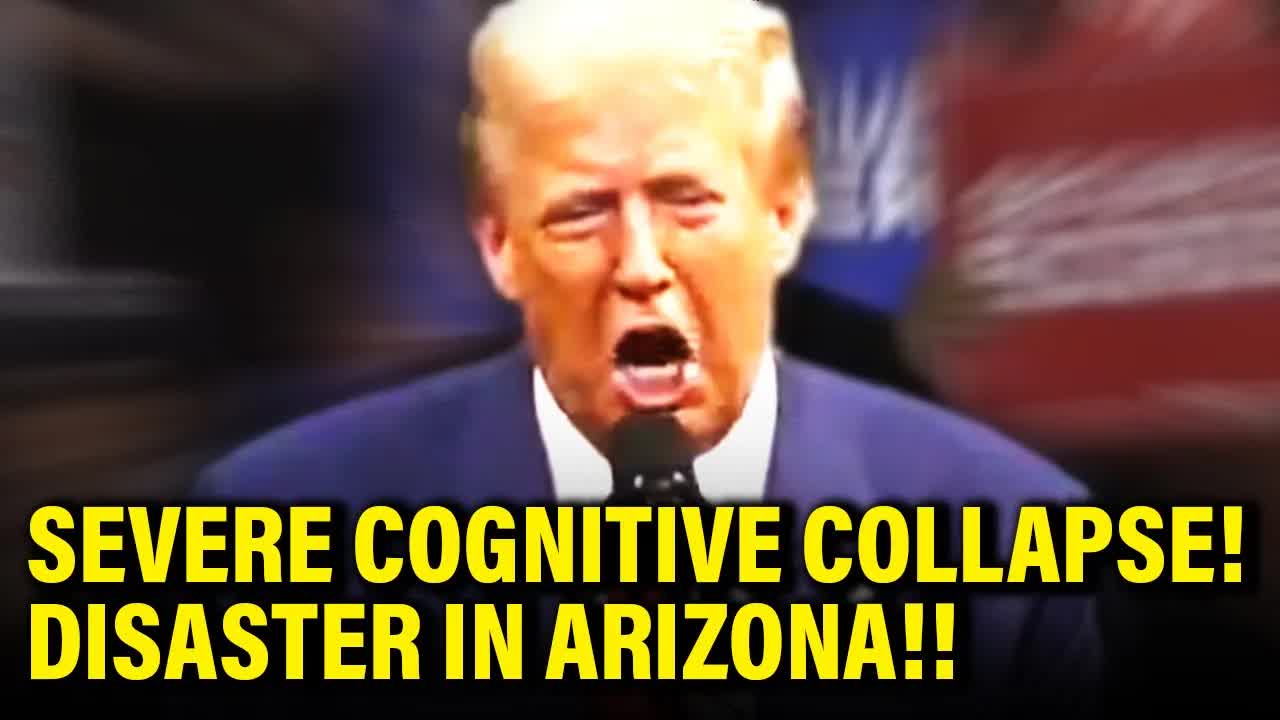
In a recent rally in Prescott Valley, Arizona, former President Donald Trump exhibited troubling signs of cognitive decline during his speech.
Observers noted his slurred speech and difficulty articulating thoughts, prompting renewed calls for him to disclose his medical history, which he has consistently withheld.
The speech showcased several baffling moments that left many questioning his mental acuity.
At one point, Trump attempted to convey a coherent thought but stumbled over his words, repeatedly uttering “Zen” in a context that seemed nonsensical.
It was unclear what he was trying to communicate, leading to confusion among attendees.
This incident was just one of many during the address that raised eyebrows about his mental state.
Trump also made an unusual claim regarding Albert Einstein, suggesting that the renowned physicist considered him the smartest person in history.
In a bizarre repetition, he insisted that Einstein had said “Trump,” which left many scratching their heads.
Such statements have fueled speculation about his grasp on reality and his ability to engage in logical discourse.
As he continued, Trump mispronounced the word “company,” instead saying “con.”
His verbal slip-ups were not isolated incidents; they seemed to occur frequently throughout the speech, leading critics to question his cognitive health.
He spent time discussing his lengthy rants from previous events, boasting about the size of his crowds while dismissing any concerns about his mental capabilities.
The former president’s rhetoric took a strange turn when he began discussing eugenics, referencing genetics in a way that many interpreted as dangerously reminiscent of Nazi ideology.
His comments about “strong genes” and a desire for safety alarmed some, as they drew parallels to unsettling historical contexts.
In another odd moment, Trump declared TiVo as the greatest invention ever, a statement that caught many off guard.
This seemingly random proclamation added to the perception that his thoughts were disjointed and lacked coherence.
He further claimed to have an affection for a chart he referenced, stating that he kisses it every night—a peculiar admission that left the audience bewildered.
Trump also proposed reviving the Alien Enemies Act of 1798, implying that it represented a time of stronger leadership.
He lamented the current political climate, suggesting that America is now an “occupied” nation due to immigration issues.
His portrayal of the country as conquered struck a discordant note with many who see the U.S. as a thriving democracy.
Throughout his speech, Trump’s attempts to articulate policy ideas often devolved into ramblings that lacked clarity.
He spoke about legislation and how a bill becomes law but quickly veered off-topic, recounting anecdotes about his father’s advice regarding employees needing letters of recommendation.
Such tangents only reinforced the perception of cognitive impairment.
The former president’s assertions about the 2020 election were equally perplexing.
He insisted that he would prevent a repeat of what he termed a “strange election,” despite evidence of a fair electoral process.
His fixation on past grievances seemed to overshadow any discussion of future policies or solutions.
In a striking projection of his own challenges, Trump criticized Vice President Kamala Harris, claiming that she creates scandals with every speech.
This comment resonated as a reflection of his own tumultuous tenure and the controversies that surrounded him during his presidency.
Finally, Trump praised Sheriff Joe Arpaio, a figure notorious for his controversial practices in Arizona.
His fondness for Arpaio raised eyebrows, especially given the significant legal and ethical issues associated with the sheriff’s actions during his time in office.
As Trump’s speech concluded, his remarks painted a picture of a man grappling with the realities of both his past and present.
The combination of erratic speech patterns, disjointed ideas, and troubling references has led many to question his fitness for public office.
As the political landscape evolves, the implications of his mental state will likely remain a topic of heated discussion.
Read more
