









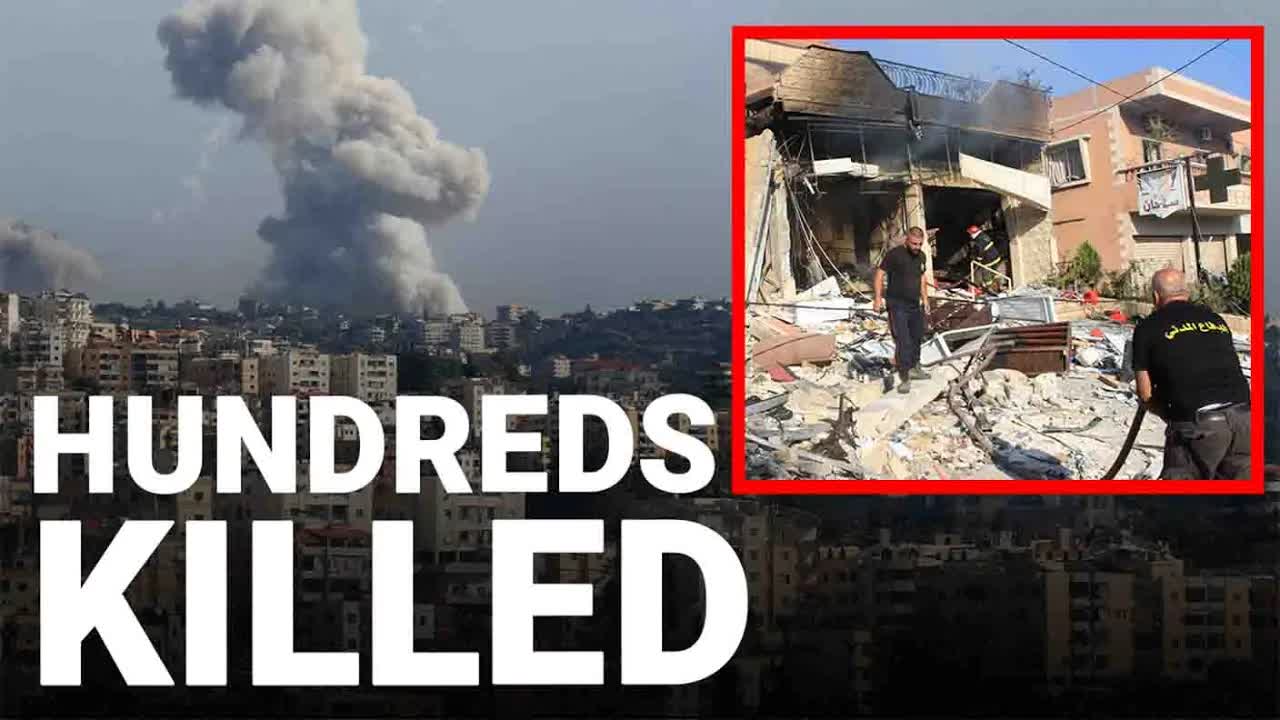
In a shocking turn of events, Lebanon has witnessed its deadliest day in over 20 years, with nearly 500 fatalities reported amidst escalating violence.
The Lebanese health ministry confirmed that among the casualties, almost 100 were women and children, making this tragedy even more heartbreaking.
This surge in violence follows a series of Israeli airstrikes targeting residential areas, raising alarm and prompting many to flee the southern regions of the country.
The situation began to unfold early yesterday morning when residents across Lebanon received alarming pre-recorded messages urging them to evacuate their homes and steer clear of any Hezbollah installations.
These warnings were widespread, even reaching government officials in Beirut.
Shortly after, the bombardment in southern Lebanon commenced, marking a significant escalation in the ongoing conflict, which has persisted for nearly a year.
The intensity of the strikes was unprecedented, leading to mass displacement as people scrambled to escape the chaos.
Traffic jams stretched from Sur, a city two hours from Beirut, all the way to the capital, as families sought refuge from the relentless airstrikes.
For the first time, shelters were established in Beirut for the displaced, and many locals opened their homes to those fleeing the violence.
The humanitarian response was immediate, showcasing the community’s resilience amid despair.
While there was one reported airstrike in the southern suburbs of Beirut, Israel claimed it targeted Ali Karaki, a senior Hezbollah leader.
However, Hezbollah refuted these claims, asserting that Karaki remains unharmed.
This incident underscores the complexities of targeting in a densely populated area where distinguishing between combatants and civilians becomes increasingly challenging.
Israel’s spokesperson released a video alleging that Hezbollah was concealing weapons within civilian residences, urging residents to distance themselves from such locations.
But this raises a critical question: how can ordinary citizens identify these supposed weapon caches?
Human rights advocates have criticized the message, arguing that it places an unreasonable burden on civilians who are already caught in the crossfire.
The staggering death toll has prompted scrutiny regarding the credibility of the information being disseminated.
While the Lebanese government provides these figures, Israel often questions the validity of statistics from Palestinian sources, citing potential biases.
However, the Lebanese health ministry, led by Firas al-Abyad, is not affiliated with Hezbollah, suggesting that the numbers may carry some weight.
In this digital age, the immediacy of social media plays a crucial role in documenting the unfolding crisis.
Videos of airstrikes and their aftermath have flooded online platforms, revealing the stark reality of civilian suffering.
Yet, the exact breakdown of casualties—whether they are civilians or fighters—remains unclear, although the impact on non-combatants is irrefutable.
The United Nations peacekeeping force in Lebanon, UNIFIL, issued a stern statement condemning attacks on civilians as violations of international humanitarian law, potentially amounting to war crimes.
This condemnation highlights the dire need for accountability amidst the chaos.
Hezbollah, established in 1982 following Israel’s invasion of southern Lebanon, has long been a staunch adversary of Israel.
Yet, the current escalation marks a pivotal moment in their decades-long struggle.
The recent airstrikes, resulting in nearly 500 deaths, represent the most lethal 24-hour period since the end of the Lebanese civil war in 1990.
As the situation unfolds, analysts emphasize the significance of timing.
With Israeli military operations in Gaza winding down, there has been a shift in focus towards the northern border with Lebanon.
The ongoing conflict has put pressure on the Israeli government, compelling them to address threats from Hezbollah as they reassess their military strategy.
The relationship between Hamas and Hezbollah complicates the landscape further.
Both groups are part of the broader pro-Iran alliance, often coordinating their efforts against Israel.
As tensions rise, the dynamics between these factions will undoubtedly influence the course of the conflict.
Looking ahead, the future remains uncertain.
The Israeli government seeks to push Hezbollah away from the border, while Hezbollah has demonstrated a reluctance to comply.
With hundreds of thousands of displaced individuals within Lebanon, the potential for a pragmatic solution may emerge, but the path forward is fraught with challenges.
The world watches closely as the situation continues to evolve, hoping for a resolution to the suffering that has gripped the region.
Read more
