






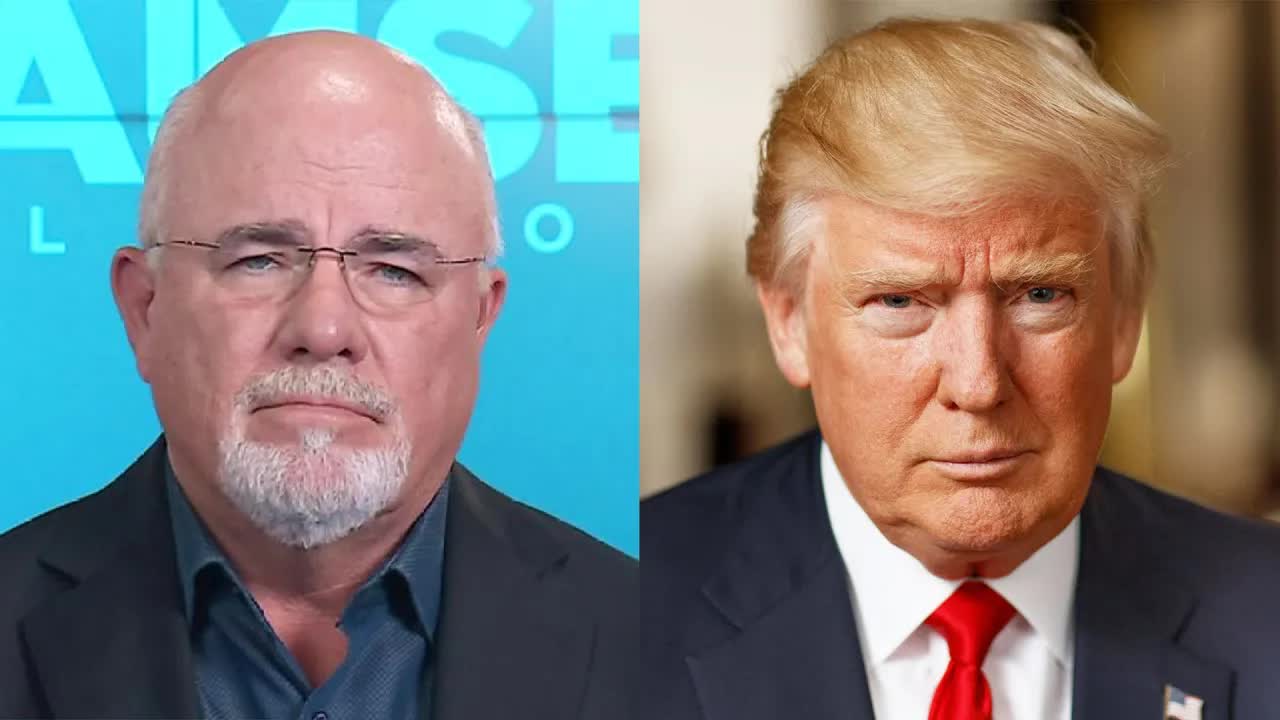
In the realm of financial advice, Dave Ramsey often positions himself as a straightforward, no-nonsense guru.
With his Southern charm and folksy demeanor, he tries to convey an image of impartiality in discussing economic issues.
However, beneath this facade lies a more complex reality that many are beginning to scrutinize, especially in light of recent claims he made regarding the economy.
Recently, Ramsey revealed that he had reached out to both Donald Trump and Kamala Harris for interviews, hoping to engage in a dialogue about pressing economic ideas.
Trump accepted the invitation, while Harris has yet to respond.
This raises an intriguing question: Why would the Vice President hesitate to engage with someone who presents himself as a neutral facilitator of discussion?
Perhaps it’s because Ramsey’s organization has a history of aligning with right-wing ideologies, particularly regarding contentious topics like COVID-19 vaccinations.
During his interview with Trump, Ramsey painted a rather dire picture of the current economic landscape.
He highlighted concerns such as exorbitant egg prices, skyrocketing gas costs, and rising mortgage interest rates.
However, upon closer inspection, it becomes evident that many of Ramsey’s assertions are either exaggerated or outright incorrect.
For instance, Ramsey claimed that eggs now cost $7 per dozen.
While some may indeed pay that for specialty eggs, the average price, as tracked by the St. Louis Fed, is around $3.20.
This discrepancy suggests that Ramsey is inflating prices by a staggering 118%, which raises doubts about his credibility as a financial analyst.
Similarly, when discussing gas prices, Ramsey mentioned $5 per gallon.
While it’s true that prices can vary significantly across the country, the national average currently sits at approximately $3.20.
This means Ramsey’s claim is off by about 56%, further calling into question the accuracy of his economic assessments.
Ramsey also addressed mortgage interest rates, stating they hover around 7%.
In reality, the national average for a 30-year fixed mortgage is closer to 6.2%, and rates are expected to decline even further in the near future.
This means Ramsey’s figures are not only inflated but also fail to account for the downward trend in interest rates.
The narrative continues as Ramsey discusses housing prices, asserting that they are increasing faster than wages.
While this may hold true in certain areas, the broader picture is far more nuanced.
Factors such as regional market differences and the availability of housing inventory play significant roles in this discussion.
Interestingly, many Republican policies tend to oppose solutions that could address these disparities, such as increasing housing supply or raising the minimum wage.
Given these inconsistencies, it’s no surprise that Kamala Harris might be reluctant to engage with Ramsey.
From a strategic standpoint, why would she want to sit down with someone who appears to distort economic realities for a particular agenda?
Engaging in a conversation with someone who has shown bias could potentially backfire.
Despite the potential pitfalls, some argue that Harris should consider the opportunity to confront Ramsey directly.
After all, engaging in dialogue could provide a platform to clarify misconceptions and present her administration’s economic policies more effectively.
As the political landscape evolves, the importance of accurate economic discourse cannot be overstated.
Misleading claims, especially from influential figures like Ramsey, can shape public perception and influence policy discussions.
It’s essential for leaders to navigate these conversations with clarity and honesty.
In the end, the debate surrounding Ramsey’s claims serves as a reminder of the complexities inherent in economic discussions.
As citizens, we must remain vigilant, questioning narratives that seem too good—or too bad—to be true.
The truth often lies in the details, and it’s our responsibility to seek it out.
Read more
