






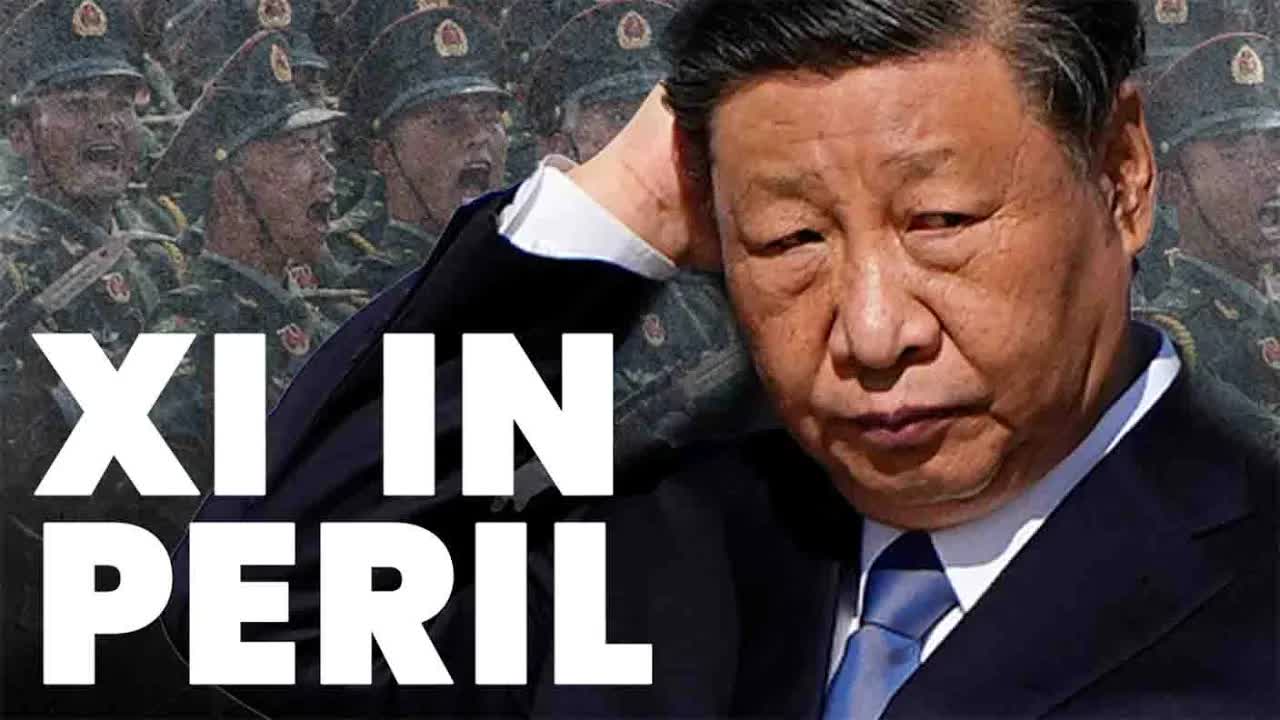
In recent months, China’s political scene has raised eyebrows, prompting discussions about the stability of its leadership.
The disappearance of key figures, including the foreign and defense ministers, alongside several high-ranking generals from the elite Rocket Force, suggests that all may not be well within the Communist Party’s ranks.
This series of events casts doubt on the notion of a stable regime, hinting at underlying dissent and unease.
While President Xi Jinping appears to hold a firm grip on power today, experts caution that the future could bring challenges, especially if the economy continues to falter.
The question remains: could Xi’s position be threatened in the next few years?
Anything is possible, as highlighted by Ai Weiwei, the renowned exiled artist.
He pointed out that throughout Chinese history, emperors who seemed invincible often faced their greatest vulnerabilities.
The current climate raises concerns about how these internal dynamics might affect global relations, particularly regarding Taiwan.
Robin Niblett, former director of Chatham House, warns that a weakened Chinese economy could lead to aggressive posturing from the Communist Party, potentially escalating tensions over Taiwan.
This perspective aligns with a growing sentiment that nationalism within China is intensifying, fueled by economic woes.
The Communist Party has increasingly adopted a nationalist agenda, fostering resentment towards groups perceived as different, such as the Uyghurs in Xinjiang and the Taiwanese.
As economic pressures mount, there is a temptation for the government to resort to nationalist rhetoric, a common tactic among autocrats facing crises.
While an outright invasion of Taiwan poses significant logistical challenges, alternative means of aggression, including cyberattacks and disinformation campaigns, are already part of the daily struggle for Taiwan.
Ian Williams, the author of “Vampire State,” draws parallels between the current Chinese regime and historical fascist economies.
He likens the Communist Party’s approach to that of the Nazi Party, suggesting that both systems manipulate economies to maintain control.
This analogy underscores the predatory nature of the Chinese government, which exploits foreign businesses while stifling dissent.
Interestingly, Halloween has become a notable occasion in China, though it comes with its own set of restrictions.
Authorities have been cracking down on costume parties, fearing a repeat of last year’s protests where costumes mocked the government’s COVID-19 response.
This year, gatherings of costumed revelers have been met with police intervention, showcasing the regime’s anxiety over public expressions of dissent, even during a seemingly innocuous celebration.
Moreover, the Chinese government’s efforts to tighten internet censorship reflect a broader fear of free expression.
Recent directives aim to curtail the spread of memes and wordplay that allow citizens to discuss sensitive topics while evading censorship.
This heightened paranoia reveals the lengths to which the Communist Party will go to maintain control over public discourse.
The aftermath of the COVID-19 pandemic has also left a significant mark on China’s economy and society.
The party’s harsh lockdown measures, which were among the strictest globally, have had lasting repercussions.
While officials may shy away from admitting it, the harsh economic consequences are evident, leading to a lack of confidence among consumers and businesses alike.
As the United States approaches its presidential election, the Chinese Communist Party faces a dilemma regarding its preferred outcome.
The unpredictability of candidates like Donald Trump, who initially embraced authoritarian leaders but later took a tough stance on China, complicates matters.
In contrast, Joe Biden’s administration has maintained a consistent approach, which may seem more manageable for the Chinese leadership.
Ultimately, both China and Russia benefit from a divided and contentious United States.
The more turmoil there is in American politics, the more it bolsters the narrative that the West is in decline.
For the Chinese Communist Party, any internal strife within the U.S. serves as an opportunity to further its interests on the global stage.
In this complex landscape, the interplay of domestic pressures and international relations will continue to shape the future of China.
As the political climate evolves, observers worldwide will be watching closely for signs of change, instability, or potentially even a shift in power dynamics.
Read more
