
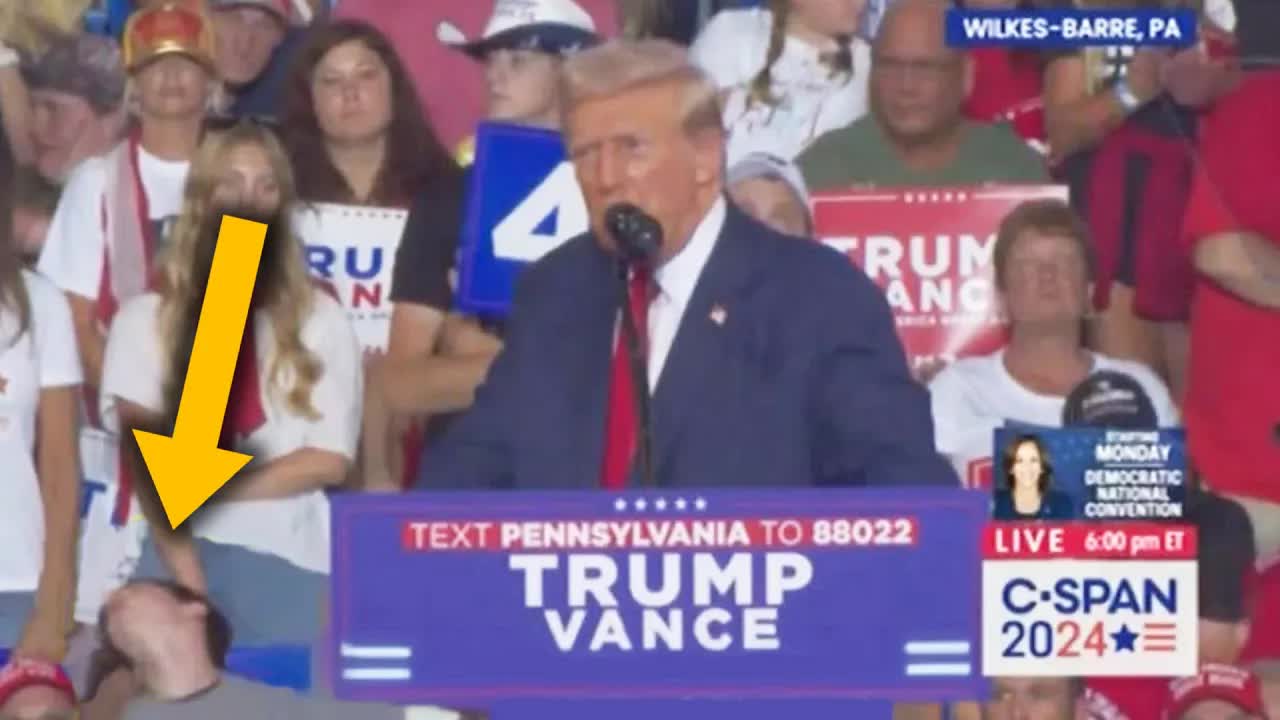
In a striking juxtaposition, recent rallies held by Donald Trump in Wilkes-Barre, Pennsylvania, and Kamala Harris alongside Tim Walz showcased two vastly different narratives for America’s future.
While Harris and Walz radiated positivity and hope, Trump delivered a speech that many observers described as dystopian, marked by moments of confusion and cognitive lapses.
During his rally, Trump seemed to struggle with basic awareness, even mistakenly referring to North Carolina while addressing a crowd in Pennsylvania.
This slip raised eyebrows, leading some to speculate whether he was experiencing more than just a verbal misstep.
However, supporters quickly pointed out that he might have been acknowledging a group of loyal fans from North Carolina who frequently attend his events.
Regardless, the moment highlighted an unsettling trend in Trump’s recent public appearances.
One particularly bizarre moment involved Trump repeating phrases like “powerful” in an almost robotic manner, leaving attendees bewildered.
His mention of Barack Obama felt out of place, with Trump fumbling over the former president’s name while seemingly struggling to articulate his thoughts.
Such instances led many to question not only his grasp on current events but also his mental acuity.
Adding to the oddity, Trump expressed admiration for TiVo technology, a relic from the late 1990s, as if it were a groundbreaking innovation.
This nostalgic reference seemed less about policy and more about reminding everyone of his age as the oldest presidential nominee in U.S. history.
It was a curious choice, especially as many in the audience appeared disengaged or even asleep by the one-hour mark of his lengthy speech.
As the rally progressed, a new narrative emerged, with Trump claiming that shoplifting under a certain monetary threshold was no longer a crime.
He painted a picture of people casually walking into stores, calculating their thefts to avoid repercussions.
This misleading assertion, which he has repeated at various events, is reminiscent of tales from his past but lacks any factual basis.
Furthermore, Trump’s understanding of tariffs was called into question as he continued to misrepresent their implications.
He insisted that tariffs are taxes solely imposed on foreign countries, neglecting to acknowledge that American consumers ultimately bear the cost.
This distortion of facts raises concerns about whether he genuinely misunderstands economic principles or deliberately spreads misinformation.
Amidst these confusing statements, Trump also took aim at Jewish Americans, suggesting that those who support Democrats need their heads examined.
This inflammatory rhetoric is unlikely to endear him to a demographic that has historically leaned toward more progressive candidates.
Such comments echo troubling historical narratives and reveal deeper insecurities within Trump’s political messaging.
In a peculiar twist, Trump also compared his looks to those of Kamala Harris, asserting he is more attractive than the vice president.
This self-referential remark underscores a level of insecurity that seems to permeate his speeches, diverting attention away from substantive policy discussions.
As the rally concluded, Trump lamented what he termed a “nation in decline,” a phrase he seems to relish.
He noted how this sentiment has been echoed by other candidates, further emphasizing his belief in the narrative of American failure.
Yet, the tone of his address stood in stark contrast to the uplifting messages delivered by Harris and Walz earlier in the day.
Attendees at Trump’s rally appeared increasingly disinterested, with many leaving before the event wrapped up.
In contrast, the Harris-Walz rally exuded energy and engagement, highlighting a desire for a hopeful vision rather than a bleak outlook.
The differences in crowd reactions spoke volumes about the contrasting atmospheres at each event.
Ultimately, the divergent narratives presented by Trump and Harris reflect broader ideological divides in American politics.
While Trump’s rhetoric may resonate with a certain base, the palpable enthusiasm at Harris’s rally suggests that many Americans are yearning for a more optimistic approach to the nation’s future.
As these rallies continue to unfold, the contrasting messages will likely shape the political landscape leading up to the next election.
With each event, voters are faced with choices that not only reflect their beliefs but also their hopes for what lies ahead.
Read more
