





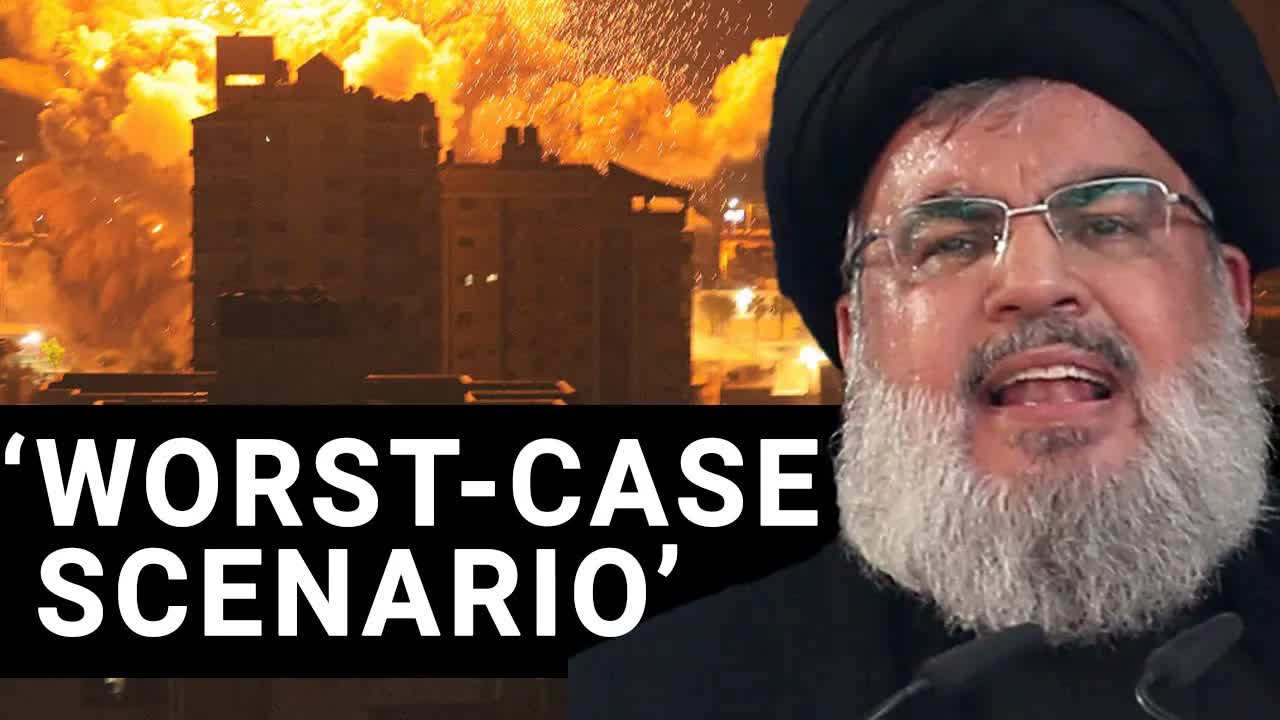
The Middle East finds itself at a critical juncture following the shocking reports of Hassan Nasrallah’s death, a figure who has long been synonymous with Hezbollah’s identity and power.
The implications of this event are profound, plunging the region into a state of uncertainty that many had feared would come to pass.
As analysts and correspondents assess the situation, one thing is clear: the coming hours will be pivotal for all parties involved.
Olivia Poitouvan, a correspondent for Lorient Today based in Beirut, provided insights into the gravity of the situation.
She noted that until recently, Hezbollah and its Iranian backers appeared confident in their ability to maintain support for Hamas after the October 8th assault on Israel.
However, recent developments have drastically shifted the landscape.
The Israeli military has executed targeted strikes that reportedly decimated key members of Hezbollah’s leadership, leaving a significant leadership void.
This vacuum at the top raises pressing questions about the future of Hezbollah.
With Nasrallah’s purported death, who will step in to lead this formidable non-state actor, known for its extensive military capabilities and a formidable arsenal of missiles?
Nasrallah was more than just a leader; he was a unifying figure whose influence extended beyond military might to political sway.
His absence creates uncertainty not only within Hezbollah but also in negotiations concerning Gaza, as he had been a crucial player in discussions between Iran, Hezbollah, and Hamas.
The emotional impact of Nasrallah’s death cannot be understated.
He was viewed as a cult-like figure by his followers, who revered him for his leadership and charisma.
The streets of Lebanon are likely to erupt with anger and grief, as many see him as a protector against external threats.
This sentiment echoes the reactions seen in the aftermath of other significant assassinations in the region, such as that of ISIS leader Abu Bakr al-Baghdadi or Iranian General Qasem Soleimani.
Yet, while some may view this as a victory for Israel, it is essential to consider the broader consequences.
History has shown that the elimination of a leader does not always equate to the resolution of underlying conflicts.
For instance, the assassination of Hamas leader Ismail Haniyeh led to the rise of Yahya al-Sinwar, a more radical figure who complicates negotiations.
Will Nasrallah’s successor emerge as a more extreme leader, further escalating tensions?
The political landscape in Lebanon is already fragile.
With a caretaker government struggling to maintain order amid an ongoing economic crisis, the nation is ill-equipped to handle the fallout from this latest upheaval.
Residents are currently facing relentless airstrikes, prompting many to seek refuge in mosques or sleep on the streets of Beirut.
The city is bracing for a wave of responses, both supportive and critical of Hezbollah’s actions and leadership.
As Olivia pointed out, the Lebanese populace is diverse, with varying opinions on Hezbollah’s role in the current conflict.
While the Shia community has largely supported the group, there is significant dissent among Christian and Sunni factions, particularly regarding the decision to engage in conflict with Israel.
This complex tapestry of allegiances and grievances suggests that the response to Nasrallah’s death will be anything but uniform.
In a conversation with The Times columnist Juliette Samuel, the potential for a major escalation in conflict was underscored.
The symbolic weight of Nasrallah’s death is immense, and while Hezbollah may be in disarray, the expectation is that Israel will seize the opportunity to assert its dominance.
The region stands on a knife’s edge, with the possibility of a full-scale war looming larger than ever.
Reflecting on the historical context, Samuel recalled her visit to the Museum of the Resistance in Southern Lebanon, where Nasrallah is celebrated as a national hero.
This legacy complicates the narrative surrounding his death; he is not merely a political figure but a symbol of resistance against perceived aggressors.
The reverberations of this event will undoubtedly be felt across Lebanon and beyond.
As the dust settles from this seismic shift, the world watches closely.
The death of Hassan Nasrallah could very well redefine the geopolitical landscape of the Middle East.
Whether it leads to a new era of peace or further entrenchment of conflict remains to be seen.
But one thing is certain: the stakes have never been higher, and the next steps taken by Hezbollah, Israel, and their respective allies will be crucial in shaping the future of the region.
Read more
