


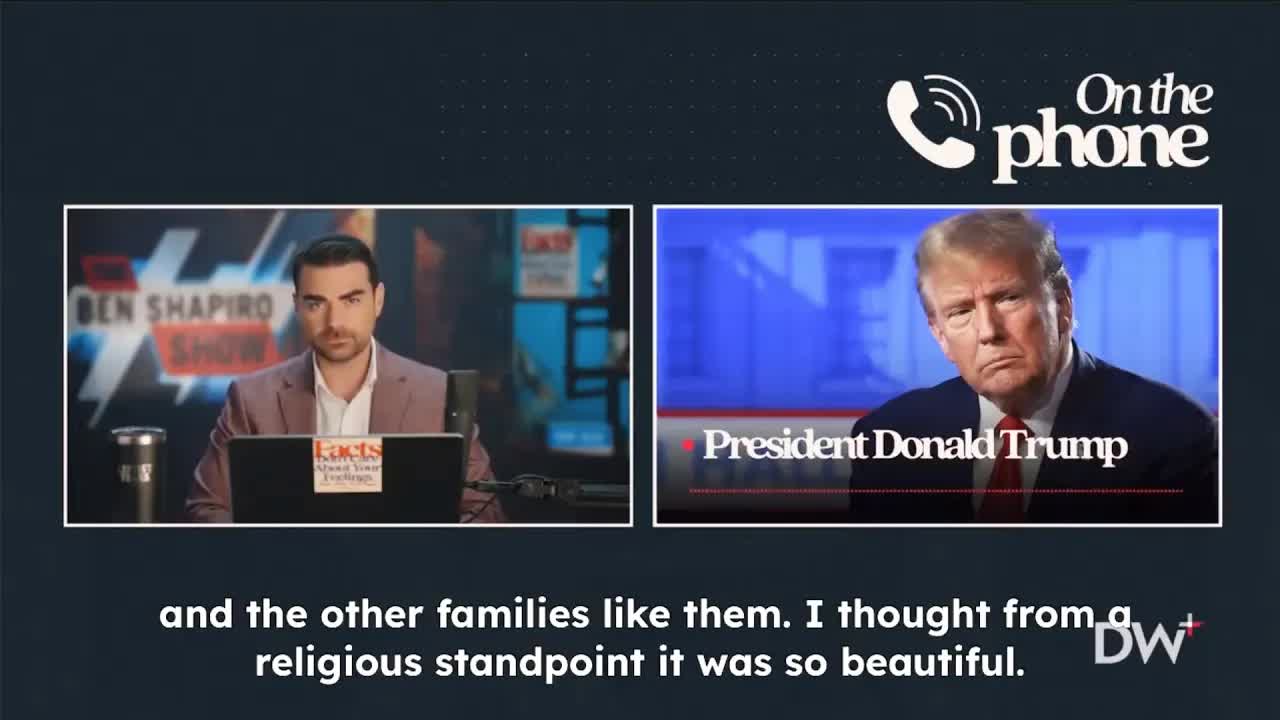
In a recent interview with conservative commentator Ben Shapiro, former President Donald Trump found himself in a series of bewildering exchanges that left even Shapiro looking perplexed.
The discussion took a notably awkward turn when Trump began to speak about Judaism, leading to moments of nervous laughter from Shapiro.
As the conversation unfolded, it became clear that Trump’s responses were more focused on self-promotion than on addressing the serious issues at hand.
The interview kicked off with Shapiro asking Trump about a family dealing with a hostage situation in Gaza.
Instead of expressing empathy or offering insights into their plight, Trump quickly shifted the focus back to himself.
“I grew up around a lot of Jewish people,” he declared, seemingly using his past experiences to validate his opinions.
His comments included an oddly detailed recollection of his upbringing in a Jewish neighborhood, which felt less like a genuine connection and more like an attempt to bolster his credentials.
While Trump did acknowledge the emotional weight of the family’s situation, his reflections seemed superficial.
He described meeting the family as a “beautiful” experience but ultimately veered back to his own narrative.
It’s hard not to notice that Trump often makes discussions about others revolve around him, showcasing an egocentric approach that can be jarring, especially in sensitive contexts.
Adding another layer to the interview’s complexity, Shapiro attempted to steer the conversation towards Trump’s views on Kamala Harris.
Trump wasted no time in criticizing her performance during a recent 60 Minutes interview, claiming she answered questions like a child.
Ironically, this critique came just moments after Trump himself had struggled to articulate coherent responses to Shapiro’s questions.
His commentary on Harris was laced with a sense of projection, as he accused her of lacking maturity while he himself rambled through his thoughts.
Trump’s tendency to deflect criticism and project his own shortcomings onto others is a recurring theme in his public appearances, and this interview was no exception.
One particularly baffling moment arose when Trump attempted to explain why he believed Putin would never have invaded Ukraine during his presidency.
His reasoning, which involved fluctuating oil prices and his personal rapport with the Russian leader, was a tangled mess of assertions that left viewers scratching their heads.
“If the right thing happened in the election, Ukraine today would be fully intact,” he claimed, suggesting that his absence from office was the catalyst for the current crisis.
As Trump continued to speak, it became increasingly difficult to discern a clear line of logic in his arguments.
His assertions about oil prices being a deterrent to invasion felt disconnected from the broader geopolitical realities, leaving many to wonder if he truly comprehended the complexities of international relations.
Throughout the interview, Shapiro maintained a supportive demeanor, yet his facial expressions betrayed a sense of disbelief.
It was apparent that even he struggled to reconcile Trump’s erratic statements with the image of a competent leader.
The dynamic between the two highlighted the challenges Trump faces in articulating a coherent narrative, regardless of the interviewer’s political alignment.
As the conversation progressed, it became evident that Trump’s attempts to engage with serious topics often devolved into self-referential anecdotes.
This pattern raises questions about his ability to connect with audiences on pressing issues, especially when his rhetoric tends to alienate rather than unite.
With the political landscape constantly shifting, Trump’s interview with Shapiro serves as a reminder of the difficulties he encounters in navigating complex discussions.
Whether speaking to friendly or critical media, his tendency to revert to self-promotion can undermine his credibility.
In the end, this interview may not only reflect Trump’s struggles but also signal a growing concern among supporters and critics alike regarding his capacity to effectively communicate in a rapidly changing world.
As the fallout from this conversation continues, it will be interesting to see how it impacts Trump’s public perception moving forward.
Read more
