






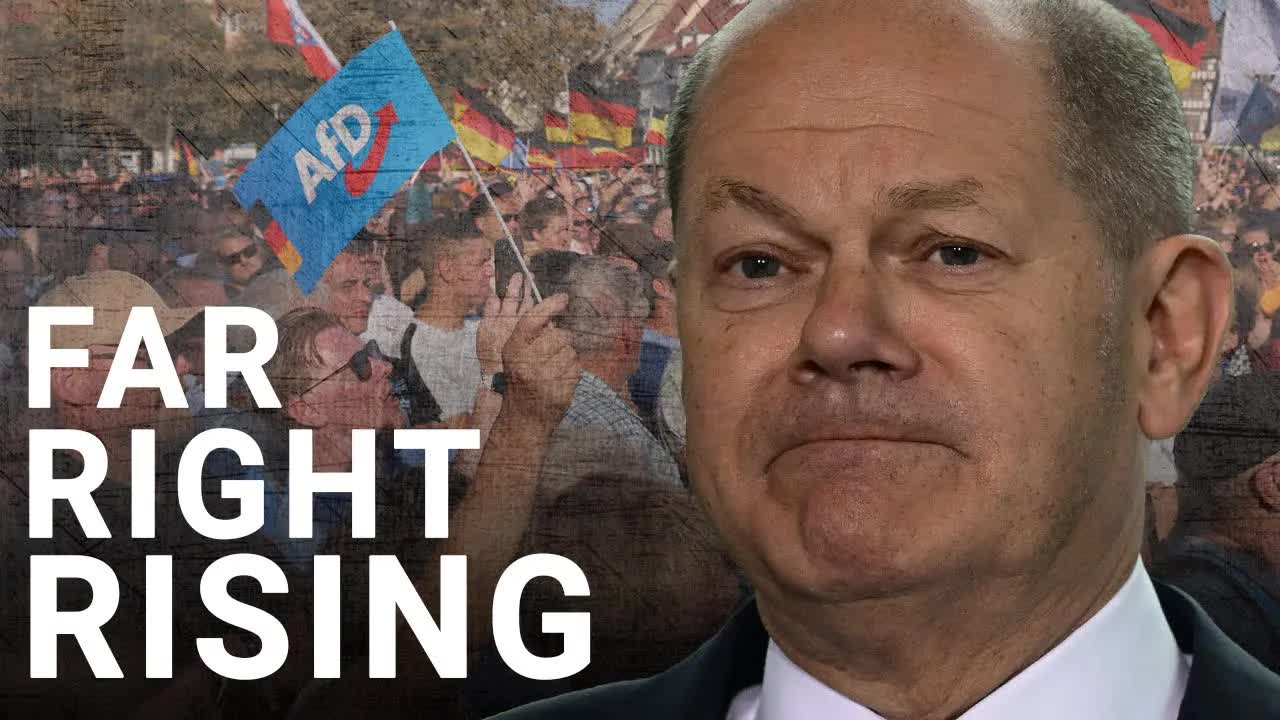
In a dramatic turn of events, the political landscape in Germany is poised for a significant shake-up as the Alternative for Germany (AFD) party appears to be gaining traction in the state of Brandenburg.
With general elections looming just a year away, this shift could spell trouble for Chancellor Olaf Scholz and his Social Democratic Party (SPD).
The stakes are high, and the implications of these developments could resonate throughout the country.
Recent polling indicates that the AFD has taken a commanding lead in Brandenburg, a region surrounding Berlin, with a striking 28-point advantage.
While Brandenburg may not be densely populated, its historical significance as a long-standing SPD stronghold since Germany’s reunification in 1990 cannot be overstated.
If the AFD manages to unseat the Social Democrats here, it could very well mark the beginning of the end for Scholz’s political career as he faces an uphill battle in the upcoming elections.
The electoral tension in Brandenburg is palpable.
Current polls show the AFD with a slim lead of between 1% and 3% over the SPD, with projections suggesting they could secure around 28% of the vote.
This potential shift is compounded by the possibility of declining support for other traditional parties that have historically been part of the state legislature, further complicating the political equation.
But what’s driving this surge in support for the AFD?
Is it the younger generation rallying behind them, or perhaps older voters who remember life in East Germany?
The reality is more nuanced; Brandenburg’s electorate is diverse, with affluent suburbs that have evolved since the fall of the Berlin Wall, alongside rural areas where agricultural concerns are paramount.
Many voters are dissatisfied with the current government’s green initiatives, particularly those regarding environmental regulations that they feel threaten their way of life.
Indeed, the AFD has tapped into a growing frustration among local residents regarding new environmental policies.
Many voters, particularly in rural areas, are rallying against the installation of wind turbines, which they believe disrupt the natural landscape and require heavy machinery that damages the environment.
This environmental sentiment has become a rallying cry for the AFD, aligning with their broader campaign themes.
Interestingly, the AFD’s support base is not solely comprised of older voters.
A noticeable trend is the influx of first-time voters, many of whom are eager to express their discontent with the current political climate.
The party’s leader in Thuringia, Björn Höcke, has actively campaigned in Brandenburg, attracting a younger audience and reshaping the perception of the AFD as a party for all ages rather than just the older demographic.
While the AFD gains momentum, another player in the political arena, the extreme left BSW party, poses a challenge to both the SPD and the CDU.
The rise of these alternative parties has created a complex dynamic, where traditional parties find themselves squeezed between opposing forces, each advocating for different aspects of economic and social policy.
This fragmentation has left many voters feeling disillusioned and seeking alternatives.
The current political landscape is further complicated by the AFD and BSW’s shared criticism of the mainstream parties, especially regarding issues like immigration and support for Ukraine.
These parties have successfully positioned themselves as voices for those who feel left behind by the establishment, thus drawing away votes from the SPD and CDU alike.
Germany’s recent decision to impose unilateral border checks, a move that caught many of its neighbors off guard, illustrates how far-right sentiments are shaping national policy.
This shift has emboldened other far-right parties across Europe, stirring a sense of urgency within the traditional political framework.
As the election approaches, the pressure on Olaf Scholz continues to mount, with the potential loss of Brandenburg acting as a catalyst for internal dissent within the SPD.
The political drama unfolding in Brandenburg is nothing short of riveting.
As the state prepares to head to the polls, the fate of Scholz and the SPD hangs in the balance.
Will they manage to retain their stronghold, or will the AFD’s rise signal a new era in German politics?
With 27% of voters still undecided, the outcome remains uncertain, leaving room for surprises that could reshape the political landscape in the coming months.
As we await the results, all eyes will be on Brandenburg.
The implications of this election extend far beyond the state borders, potentially altering the course of German politics for years to come.
Read more
